2009 AMC 10A Problem 14
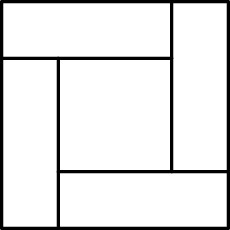
Four congruent rectangles are placed as shown. The area of the outer square is times that of the inner square. What is the ratio of the length of the longer side of each rectangle to the length of its shorter side?
Show solution without answering
Key insight
The outer square's side is a + b and the inner square's is a - b. Four times the area means twice the side.
Solution
Call each rectangle's longer side and its shorter side .
1. Walk along one side of the outer square. You pass the long side of one rectangle and then the short side of the next one. So the outer square has side .
2. Walk along one side of the inner square. It runs along the long side of one rectangle, except for the part covered by the short side of its neighbor. So the inner square has side .
3. The outer area is times the inner area. Since , the outer side is times the inner side:
4. Expand and solve: , so . The ratio of long side to short side is .
5. Check with , : the outer square has side and area ; the inner square has side and area . And .
The answer is .
Why this works
In this pinwheel of four rectangles, the outer square's side is the sum of the rectangle's sides and the inner square's side is their difference. When areas are compared, take square roots to compare sides: an area times as big means sides times as long.
Alternative approach
Use areas instead. The outer square is the inner square plus the four rectangles. With the numbers from the check above (, ): . In general, can be expanded to , which simplifies to , or . Since is the longer side, .
Concise solution
A shorter write-up, the way contest solutions are usually written. It may take a different route from the solution above.
Let each rectangle have longer side and shorter side .
Along one side of the outer square we see a long side of one rectangle followed by a short side of the next, so the outer square has side . Along one side of the inner square we see a long side minus the short side that overlaps it, so the inner square has side .
The area condition gives
taking positive square roots. Then , so and .
Check with , : outer square , inner square , ratio .
The answer is .
Review in the AoPS books
- Introduction to Geometry, Chapter 8: Quadrilaterals
- Introduction to Algebra, Chapter 11: Special Factorizations (§11.2, §11.3, §11.5)
- Introduction to Geometry, Chapter 9: Polygons (§9.3)
- Introduction to Algebra, Chapter 22: Special Manipulations
Similar problems
Problem © Mathematical Association of America (MAA), American Mathematics Competitions. Reproduced for non-commercial educational use. Solution and commentary are original to this site.