2009 AMC 10A Problem 15
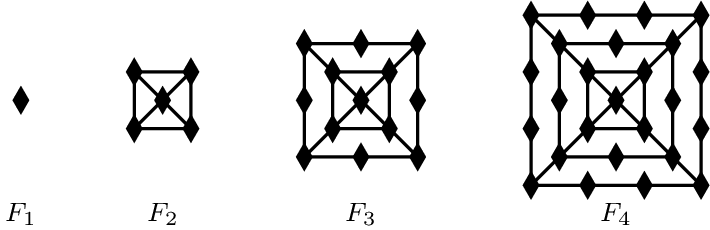
The figures , , , and shown are the first in a sequence of figures. For , is constructed from by surrounding it with a square and placing one more diamond on each side of the new square than had on each side of its outside square. For example, figure has diamonds. How many diamonds are there in figure ?
Show solution without answering
Key insight
Each new ring with n diamonds per side holds 4(n - 1) diamonds, so F_20 = 1 + 4(1 + 2 + ... + 19) = 761.
Solution
1. Count the first figures: , , , . The jumps are .
2. See where the jumps come from. The new outside square of has diamonds on each side. Four sides of would be , but the corner diamonds are each counted twice, so the ring holds diamonds. For that is , for it is . This matches.
3. So each figure is the one before plus , and
4. The sum is .
5. So .
6. Check the method on a figure we know: . Correct.
The answer is .
Why this works
When a figure grows by adding a layer each time, count what one layer adds, then add up the layers. Here the layers add , so the total uses the sum . Always test your method on the figures the problem shows you before using it for .
Alternative approach
Look at the diamonds in rows along the diagonals. is an by grid of diamonds with an by grid fitted into the gaps: and . So .
Concise solution
A shorter write-up, the way contest solutions are usually written. It may take a different route from the solution above.
Count the diamonds in the first figures: , , , . The increases are .
Why: the outer square of has diamonds on each side, and a square with diamonds per side contains diamonds (four corners are shared). So
Summing the increments from :
Check: and , matching the figure.
Then .
The answer is .
Review in the AoPS books
- Introduction to Algebra, Chapter 21: Sequences & Series (§21.1, §21.2, §21.3, §21.4)
- Prealgebra, Chapter 15: Problem-Solving Strategies (§15.1)
- Intermediate Algebra, Chapter 17: More Sequences and Series (§17.1, §17.2)
- Introduction to Number Theory, Chapter 12: Introduction to Modular Arithmetic (§12.6)
Similar problems
Problem © Mathematical Association of America (MAA), American Mathematics Competitions. Reproduced for non-commercial educational use. Solution and commentary are original to this site.