2006 AMC 10A Problem 7
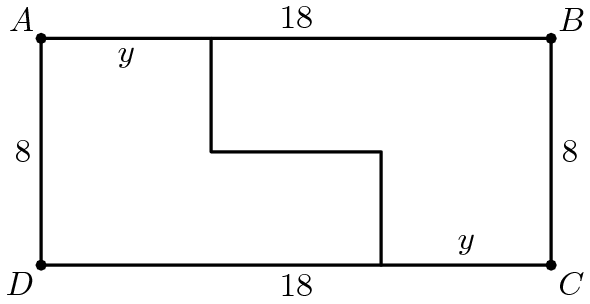
The rectangle is cut into two congruent hexagons, as shown, in such a way that the two hexagons can be repositioned without overlap to form a square. What is ?
Show solution without answering
Key insight
Moving pieces does not change area, so the square has area 144 and side 12. The long edge 18 − y of each hexagon becomes a side of the square.
Solution
Start with what cannot change when you cut and move pieces: the total area.
1. Size of the square. The rectangle has area . The square is made of the same two pieces, so its area is also , and its side is (because ).
2. Read the figure. The cut starts on the top edge, goes down (half the height of ), goes across, then goes down another to the bottom edge. The left hexagon has a short top edge of length and a long bottom edge of length . The right hexagon is the same shape turned upside down.
3. Build the square. Lift the right hexagon up by and slide it left so the two "steps" of the cut fit together. The height becomes , which matches the square. The long edges of the hexagons are now the top and bottom sides of the square, so
4. Check. The middle, horizontal part of the cut has length , which equals . So the short edges fit exactly into the notches, with no gaps.
The answer is .
Why this works
In any cut-and-rearrange problem, area stays the same, and that usually tells you the size of the new shape right away. Then match one edge of a piece to a side of the new shape to get an equation. Checking a second edge confirms that the pieces really fit.
Alternative approach
For the two steps to lock together, the three horizontal pieces along the length (the top edge , the middle of the cut, and the bottom edge of the other piece) must all be the same length. Three equal pieces make , so .
Concise solution
A shorter write-up, the way contest solutions are usually written. It may take a different route from the solution above.
Cutting and moving pieces never changes total area, so the square has area and side .
Now read the figure. The cut goes down (half the height), across, and down again. The left hexagon has a short top edge of length and a long bottom edge running from to the foot of the cut, of length ; the right hexagon is the same piece turned around, with a long top edge and short bottom edge .
To build the square, slide the right hexagon up by and left so that the two steps interlock. The stacked heights match the square, and the two long edges become the top and bottom sides of the square. Hence
Consistency check: the middle horizontal segment of the cut has length , so the two short edges fit exactly into the notches, as a square with no gaps requires.
The answer is .
Review in the AoPS books
- Introduction to Geometry, Chapter 8: Quadrilaterals
- Introduction to Geometry, Chapter 16: The More Things Change. . . (§16.1, §16.2, §16.3, §16.4)
- Introduction to Geometry, Chapter 9: Polygons (§9.3)
Similar problems
Problem © Mathematical Association of America (MAA), American Mathematics Competitions. Reproduced for non-commercial educational use. Solution and commentary are original to this site. Also appeared as 2006 12A #6.