2016 AMC 10A Problem 10
A rug is made with three different colors as shown. The areas of the three differently colored regions form an arithmetic progression. The inner rectangle is one foot wide, and each of the two shaded regions is foot wide on all four sides. What is the length in feet of the inner rectangle? 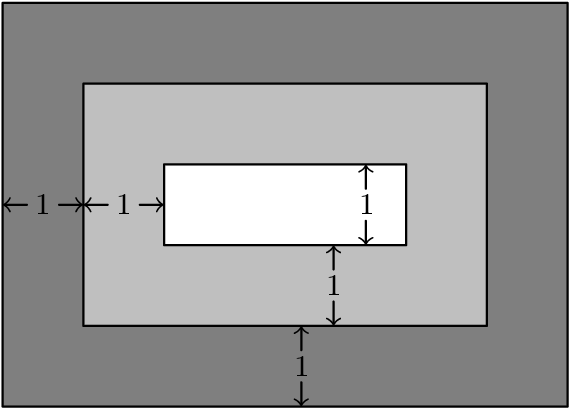
Show solution without answering
Key insight
With inner length x, the colored areas are x, 2x + 6 and 2x + 14. Equal gaps need x + 6 = 8, so x = 2.
Solution
Each colored region is a rectangle with a smaller rectangle cut out of its middle, so find the three rectangle sizes first.
1. Let the inner rectangle be foot wide and feet long.
2. A -foot border on all four sides adds feet to each dimension. So the middle rectangle is by , and the outer rectangle is by .
3. Now find the area of each colored region:
- Inner region: .
- Middle ring: the by rectangle minus the inner rectangle: .
- Outer ring: the by rectangle minus the middle rectangle: .
4. In an arithmetic progression, the gap from first to second equals the gap from second to third.
- First gap: .
- Second gap: .
5. So and .
Check: the areas are , , , which go up by each time.
The answer is .
Why this works
The area of a frame is always the outer rectangle minus the inner one. Each area here is a simple expression in , and "arithmetic progression" just means the two gaps are equal, which gives one easy equation.
Alternative approach
Test the choices. With the three rectangles are , and , with areas , , . The colored regions are , and , evenly spaced. With they would be , , , which are not evenly spaced.
Concise solution
A shorter write-up, the way contest solutions are usually written. It may take a different route from the solution above.
Let the inner rectangle be by . Adding a -foot border on every side gives a middle rectangle of size by , and another border gives the outer rectangle of size by .
The three colored regions have areas
For an arithmetic progression the consecutive differences must agree:
So and . (Check: areas .)
The answer is .
Review in the AoPS books
- Introduction to Geometry, Chapter 8: Quadrilaterals
- Introduction to Algebra, Chapter 21: Sequences & Series (§21.1, §21.2, §21.3, §21.4)
- Introduction to Geometry, Chapter 4: Perimeter and Area (§4.2, §4.3)
- Introduction to Geometry, Chapter 9: Polygons (§9.3)
Similar problems
Problem © Mathematical Association of America (MAA), American Mathematics Competitions. Reproduced for non-commercial educational use. Solution and commentary are original to this site.