2003 AMC 10B Problem 4
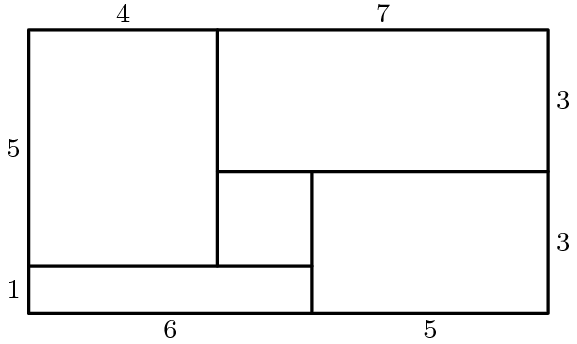
Rose fills each of the rectangular regions of her rectangular flower bed with a different type of flower. The lengths, in feet, of the rectangular regions in her flower bed are as shown in the figure. She plants one flower per square foot in each region. Asters cost each, begonias each, cannas each, dahlias each, and Easter lilies each. What is the least possible cost, in dollars, for her garden?
Show solution without answering
Key insight
Find the five areas from the figure (21, 20, 15, 6, 4). To spend the least, put the cheapest flower in the biggest region and the priciest in the smallest.
Solution
- Read the outside of the figure. Across the top: feet. Down the left side: feet. So the bed is by .
- Work out each region's sides, using the labels and subtraction:
| Region | Sides | Area |
|---|---|---|
| top right | ||
| top left | ||
| bottom right | ||
| bottom strip | ||
| small middle piece |
The middle piece is wide (the bottom strip is long, the top-left block is wide) and tall.
3. Check: , and . Every square foot is counted once.
4. Each square foot gets one flower. To keep the bill small, the cheapest flower should fill the biggest region and the most expensive flower the smallest region. So pair prices with areas :
The answer is .
Why this works
If a pricier flower sat in a bigger region than a cheaper flower, swapping those two flowers would lower the total. So the cheapest plan has prices going up exactly as areas go down. Most of the real work here is reading the figure carefully; checking that the areas add up to the whole bed catches mistakes.
Concise solution
A shorter write-up, the way contest solutions are usually written. It may take a different route from the solution above.
The whole bed is feet wide () and feet tall (). Its five rectangular regions have dimensions
- top right: , area ;
- upper left: , area ;
- lower right: , area ;
- bottom strip: , area ;
- the leftover middle piece: , area .
Check: , the area of the whole bed.
Each region gets one kind of flower, one plant per square foot. To make the total as small as possible, the cheapest flower should cover the most ground and the most expensive the least, so match prices with areas in that order:
The answer is .
Review in the AoPS books
- Introduction to Geometry, Chapter 8: Quadrilaterals
- Introduction to Algebra, Chapter 20: Special Functions (§20.2, §20.5)
- Introduction to Geometry, Chapter 9: Polygons (§9.3)
- Introduction to Algebra, Chapter 15: More Inequalities (§15.1, §15.3, §15.4)
Similar problems
Problem © Mathematical Association of America (MAA), American Mathematics Competitions. Reproduced for non-commercial educational use. Solution and commentary are original to this site. Also appeared as 2003 12B #3.