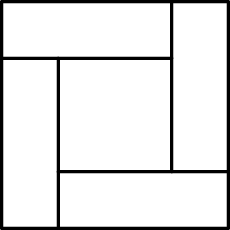
Four congruent rectangles are placed as shown. The area of the outer square is times that of the inner square. What is the ratio of the length of the longer side of each rectangle to the length of its shorter side?
- A)
- B)
- C)
- D)
- E)
Answer
A
Key insight
The outer square has side a + b and the inner square side a - b, so an area ratio of 4 means a + b = 2(a - b).
Solution
Let each rectangle have longer side and shorter side .
Along one side of the outer square we see a long side of one rectangle followed by a short side of the next, so the outer square has side . Along one side of the inner square we see a long side minus the short side that overlaps it, so the inner square has side .
The area condition gives
taking positive square roots. Then , so and .
Check with , : outer square , inner square , ratio .
The answer is .
Why this works
This pinwheel of rectangles is a classic configuration: the outer side is and the inner side is , so the two squares encode the sum and difference of the rectangle's sides. A ratio of areas becomes a ratio of sides by a square root, and then one linear equation determines .
Alternative approach
Area bookkeeping: the outer square equals the inner square plus four rectangles, so , an identity. Combined with this gives , i.e. , so and .
The trap
Taking the inner square's side to be a or b rather than a - b, or turning the area ratio 4 into a side ratio 4 instead of 2.
Common mistakes
- Taking the inner square's side to be a or b rather than a - b, or turning the area ratio 4 into a side ratio 4 instead of 2.
- Solving and reporting the root instead of the ratio of longer to shorter.
Techniques
Set up the equation/formula and compute; no special trick needed