2004 AMC 10A Problem 21
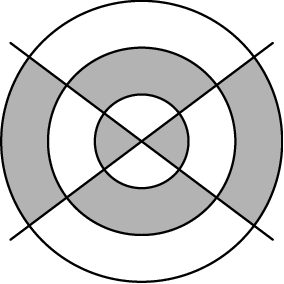
Two distinct lines pass through the center of three concentric circles of radii 3, 2, and 1. The area of the shaded region in the diagram is of the area of the unshaded region. What is the radian measure of the acute angle formed by the two lines? (Note: radian is degree.)
Show solution without answering
Key insight
The shaded area works out to 3 pi + 3 theta, and it is 8 parts out of 8 + 13 = 21 parts of the whole 9 pi.
Solution
1. Call the acute angle between the lines . The two lines cut every circle into four wedges: two opposite wedges with angle and two with angle .
2. A full turn is , so the two opposite wedges with angle together take up of any ring. The other two take up .
3. Find the area of each ring, from the inside out:
- inner disk (radius ): ,
- middle ring (between radius and ): ,
- outer ring (between radius and ): .
4. From the diagram, the inner disk and the outer ring are shaded in the two narrow wedges, and the middle ring is shaded in the two wide wedges. So the shaded area is
5. The whole figure has area . Shaded is to unshaded as is to , so the shaded part is parts out of . That means
6. Solve: , so .
The answer is .
Why this works
A wedge of a circle takes up the same fraction of the area as its angle takes of the full turn. Breaking the figure into rings makes the shaded area a simple expression in . The other key step is changing "shaded is of unshaded" into "shaded is of everything." Quick check: if were , only the middle ring would be shaded, and the formula gives .
Concise solution
A shorter write-up, the way contest solutions are usually written. It may take a different route from the solution above.
Let be the acute angle between the lines. The lines cut the plane into two opposite wedges of angle and two of angle . A pair of opposite wedges of angle takes up the fraction of any ring centered at .
The three rings have areas (inner disk), (middle ring) and (outer ring). In the diagram, the inner disk and the outer ring are shaded in the acute wedges, while the middle ring is shaded in the obtuse wedges. So
The whole figure has area . Shaded is of unshaded, so shaded is of the total:
Thus , and the answer is .
Review in the AoPS books
- Introduction to Geometry, Chapter 11: Circles
- Introduction to Algebra, Chapter 6: Ratios and Percents
- Introduction to Geometry, Chapter 4: Perimeter and Area (§4.2, §4.3)
- Introduction to Geometry, Chapter 12: Circles and Angles
Similar problems
Problem © Mathematical Association of America (MAA), American Mathematics Competitions. Reproduced for non-commercial educational use. Solution and commentary are original to this site.