2004 AMC 10A Problem 22
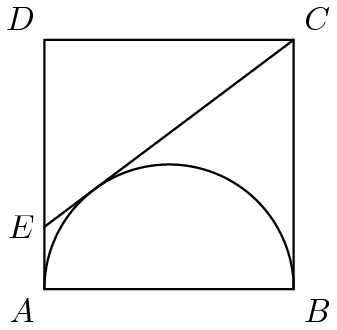
Square has side length . A semicircle with diameter is constructed inside the square, and the tangent to the semicircle from intersects side at . What is the length of ?
Show solution without answering
Key insight
Sides BC and AD also touch the semicircle, so equal tangent lengths give CE = 2 + x and DE = 2 - x; the Pythagorean theorem finds x.
Solution
1. Let be the point where segment touches the semicircle.
2. Sides and are perpendicular to the diameter at its ends, so they also just touch the semicircle, at and at .
3. From a point outside a circle, the two segments that just touch the circle have equal length. Use this twice.
- From : .
- From : . Call this length .
4. Now write two lengths using :
5. Triangle has a right angle at , with legs and . By the Pythagorean theorem,
6. Multiply out: . The terms cancel, leaving , so .
7. So . Check: the triangle has sides , , , which is a -- triangle cut in half.
The answer is .
Why this works
When lines touch a circle, mark every touching point and label the equal lengths from each outside point. That turns the circle problem into adding and subtracting lengths. Here the square's own sides are hidden touching lines, which is why the unknown shows up both along and along , and one right triangle finishes the job.
Alternative approach
Use coordinates. Put , , , . The semicircle has center and radius .
- Point is for some . The line through and must be exactly unit from the center .
- The line through with slope has distance from . Setting this equal to gives , so and .
- Going left units from drops the line by , so .
- Then .
Concise solution
A shorter write-up, the way contest solutions are usually written. It may take a different route from the solution above.
Let be the point where touches the semicircle. Because and are perpendicular to the diameter at its endpoints, they are tangent to the semicircle at and .
Equal tangents from an external point:
- From : .
- From : . Call this length .
Then , while along the side .
Apply the Pythagorean theorem to right triangle (right angle at ):
Expanding, , so and .
Therefore . (Check: , , is a scaled -- triangle.)
The answer is .
Review in the AoPS books
- Introduction to Geometry, Chapter 11: Circles
- Introduction to Geometry, Chapter 4: Perimeter and Area (§4.2)
- Introduction to Geometry, Chapter 19: Problem Solving Strategies in Geometry (§19.1)
- Introduction to Geometry, Chapter 12: Circles and Angles
Similar problems
Problem © Mathematical Association of America (MAA), American Mathematics Competitions. Reproduced for non-commercial educational use. Solution and commentary are original to this site. Also appeared as 2004 12A #18.