2025 AMC 10A Problem 22
A circle of radius is surrounded by three circles, whose radii are 1, 2, and 3, all externally tangent to the inner circle and externally tangent to each other, as shown in the diagram below.
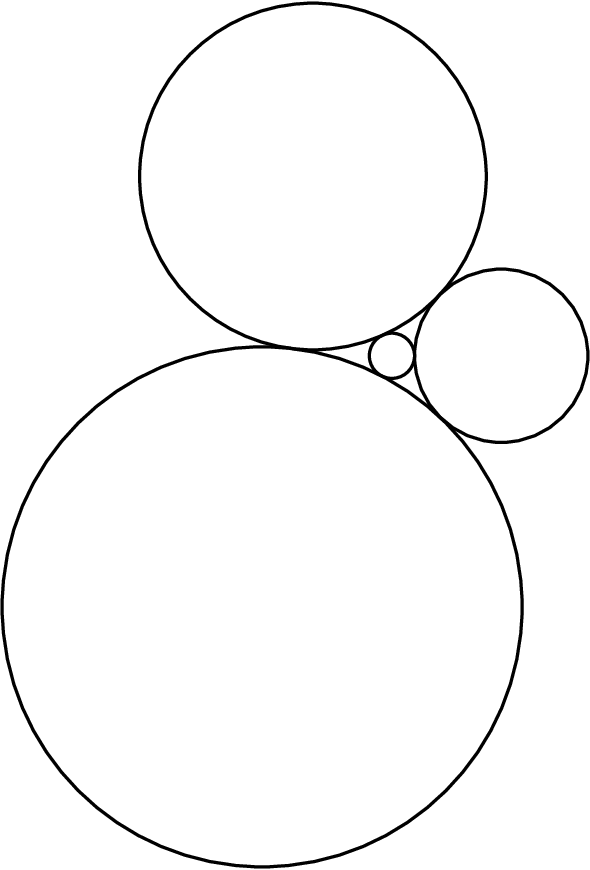
What is ?
Show solution without answering
Key insight
The three outer centers are 3, 4 and 5 apart, a right triangle. Put it on coordinate axes and write the small circle's distance to each outer center.
Solution
When two circles touch from the outside, the distance between their centers is the sum of their radii. So every "touching" in the picture becomes a distance between centers. Start there.
1. Name the centers. Call the centers of the circles with radius by the letters , and call the center of the small circle . Then
2. Spot the right triangle. The sides satisfy , so triangle has a right angle at . That makes coordinates easy: put
and let the small center be .
3. Write the three distances as equations.
4. Subtract to get rid of the squares. Every equation contains , so subtracting (1) from the others cancels those squares and leaves simple equations.
- (2) minus (1): . So , and .
- (3) minus (1): . So , and .
5. Put and back into (1).
Multiply both sides by to clear the fractions ( and ):
6. Quadratic formula. The number under the square root is . So
The other root, , is negative, so it is not a radius.
- Check. With : and . Then , and . It works.
The answer is .
Why this works
Circles that touch are really a statement about distances between centers, so the picture becomes a set of distance equations. Subtracting two circle equations cancels the squared terms, which is why and came out as simple expressions in , leaving one equation in one unknown. The step that keeps the algebra short is noticing the -- right triangle and putting its right angle at . The answer choices are all between and , so guessing from the picture will not work; the exact calculation is needed.
Alternative approach
If you have seen Descartes' Circle Theorem, it gives the answer in two lines. For each circle, take its "curvature", which is divided by its radius. When four circles all touch each other, the fourth curvature is
Here , , . Their sum is , and . So .
The plus sign gives , the small circle in the middle, so . (The minus sign gives , which stands for the big circle of radius that wraps around all three.) This is a formula to memorize, not one you can rebuild during the test, so the coordinate method above is the safer plan.
Concise solution
A shorter write-up, the way contest solutions are usually written. It may take a different route from the solution above.
Write , , for the centres of the circles of radii and for the centre of the small circle. External tangency means each centre distance is the sum of the two radii:
Since , triangle has a right angle at . That is the gift of the problem: set up coordinates with
and let .
From we have . Subtracting this from kills the quadratic terms:
Subtracting it from in the same way:
Now substitute back into :
Multiplying by and collecting terms,
The discriminant is , so
(the other root is negative). As a check, and , and .
The answer is .
Review in the AoPS books
- Introduction to Geometry, Chapter 11: Circles
- Introduction to Geometry, Chapter 17: Analytic Geometry
- Introduction to Geometry, Chapter 12: Circles and Angles
- Introduction to Algebra, Chapter 8: Graphing Lines
Similar problems
Problem © Mathematical Association of America (MAA), American Mathematics Competitions. Reproduced for non-commercial educational use. Solution and commentary are original to this site.