2004 AMC 10A Problem 20
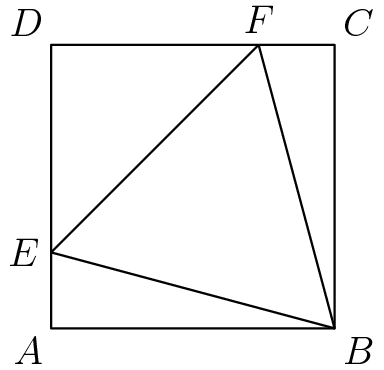
Points and are located on square so that is equilateral. What is the ratio of the area of to that of ?
Show solution without answering
Key insight
With side 1 and AE = CF = t, setting sides BE and EF equal gives (1 - t) squared = 2t, which makes the ratio exactly 2.
Solution
1. Let the square have side . Point is on side and is on side . Call .
2. The picture is symmetric. Triangles and both have a right angle, a leg of length (sides and ), and equal long sides (, since the triangle is equilateral). Two right triangles with a matching leg and matching long side are the same size and shape. So too.
3. That means and , so triangle is a right triangle with two equal legs.
4. Use the equilateral triangle. Its sides and are equal, so their squares are equal. Use the Pythagorean theorem on each:
- In triangle : .
- In triangle : .
5. Set them equal and simplify:
6. We want the areas, and area of uses . Expand it and use step 5:
7. Now the two areas are
8. Their ratio is .
The answer is .
Why this works
The figure is symmetric about the diagonal , which leaves just one unknown length. The equal sides of the equilateral triangle give one equation. Then, instead of solving for (which is ), use the equation to simplify the ratio directly. When a problem asks for a ratio, the messy numbers often cancel if you let them.
Alternative approach
Use angles. The angle at in the square is and the equilateral triangle uses of it, leaving , split equally by symmetry: on each side. So . Then and
which is the same fact as step 6, and the ratio is again .
Concise solution
A shorter write-up, the way contest solutions are usually written. It may take a different route from the solution above.
Let the square have side , with on and on , and put .
Right triangles and have equal legs and equal hypotenuses , so they are congruent (hypotenuse-leg). Hence as well, and .
Now express the equilateral side two ways. From right triangle : . From right isosceles triangle : . Setting them equal,
We do not need itself. Rewrite the relation as . Then
The areas are and . Their ratio is
The answer is .
Review in the AoPS books
- Introduction to Geometry, Chapter 4: Perimeter and Area (§4.2)
- Introduction to Geometry, Chapter 3: Congruent Triangles
- Introduction to Algebra, Chapter 22: Special Manipulations (§22.3)
- Introduction to Algebra, Chapter 11: Special Factorizations
Similar problems
Problem © Mathematical Association of America (MAA), American Mathematics Competitions. Reproduced for non-commercial educational use. Solution and commentary are original to this site.