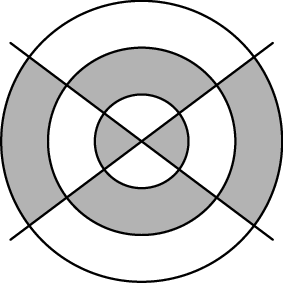
Two distinct lines pass through the center of three concentric circles of radii 3, 2, and 1. The area of the shaded region in the diagram is of the area of the unshaded region. What is the radian measure of the acute angle formed by the two lines? (Note: radian is degree.)
- A)
- B)
- C)
- D)
- E)
Answer
B
Key insight
Shaded area is 3 pi + 3 theta, and shaded is 8/21 of the total 9 pi, so 3 theta = 3 pi / 7.
Solution
Let be the acute angle between the lines. The lines cut the plane into two opposite wedges of angle and two of angle . A pair of opposite wedges of angle takes up the fraction of any ring centered at .
The three rings have areas (inner disk), (middle ring) and (outer ring). In the diagram, the inner disk and the outer ring are shaded in the acute wedges, while the middle ring is shaded in the obtuse wedges. So
The whole figure has area . Shaded is of unshaded, so shaded is of the total:
Thus , and the answer is .
Why this works
Sector areas are proportional to their angles, so the shaded area is linear in once the figure is decomposed into rings. Converting the part-to-part ratio into the part-to-whole fraction is the other essential step. Sanity check: at only the full middle ring () would be shaded, matching the constant term.
The trap
Taking the shaded area to be 8/13 of the total area instead of 8/13 of the unshaded area.
Common mistakes
- Taking the shaded area to be 8/13 of the total area instead of 8/13 of the unshaded area.
- Misreading which wedges are shaded in the middle ring, which produces and no valid answer.
Techniques
Set up the equation/formula and compute; no special trick needed · Cut the figure into known shapes (triangles, rectangles, sectors)