2025 AMC 10B Problem 12
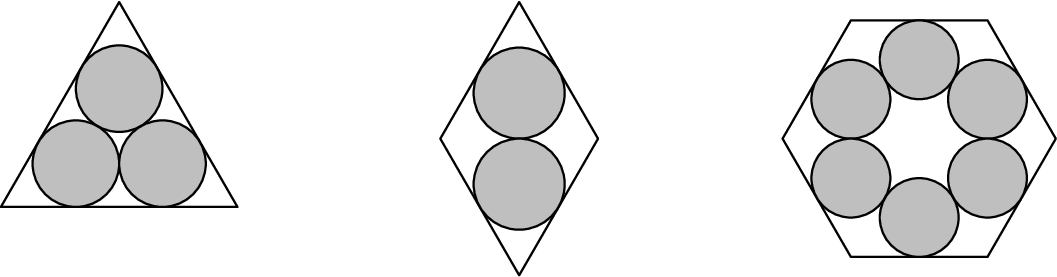
The figure below shows an equilateral triangle, a rhombus with a angle, and a regular hexagon, each of them containing some mutually tangent congruent disks. Let and respectively, denote the ratio in each case of the total area of the disks to the area of the enclosing polygon. Which of the following is true?
Show solution without answering
Key insight
Cut the hexagon into six equilateral triangles and the rhombus into two: each disk is the circle inside one triangle, so H = R.
Solution
Each ratio stays the same if you enlarge or shrink a picture, so you can treat the three pictures separately, at whatever size is easiest.
Step 1: the hexagon. Draw the three long diagonals of the hexagon. They cut it into equilateral triangles meeting at the center. The circle drawn inside an equilateral triangle touches each side at its midpoint. So the circles inside two neighbouring triangles both touch their shared side at the same point, its midpoint, and touch each other there. Each also touches one side of the hexagon. That is exactly the picture, so the six disks are the six circles inside these triangles.
Step 2: the rhombus. A rhombus with a angle is two equilateral triangles joined along the short diagonal. By the same reasoning, the two disks are the circles inside those two triangles, touching at the midpoint of the short diagonal.
So and are both "circle inside an equilateral triangle, divided by the triangle", and .
Step 3: the value of and . Take a triangle of side . Its height is and its area is . The inside circle's center is one-third of the way up the height, so its radius is and its area is . So
Step 4: the triangle with three disks. Give each disk radius . Look at the bottom-left disk. It touches the bottom side and the left side, which meet at a corner. Its center sits on the line cutting that corner in half, where the two angles are. The -- triangle made by the corner, the center, and the point where the disk touches the bottom has short side , so its long leg along the bottom is .
So along the bottom side, from left to right: to below the first center, then between the two bottom centers (the disks touch), then to the right corner. The side is
The area is , while the three disks have area . So
Step 5: compare. is bigger than , so .
The answer is .
Why this works
Shapes built from angles can be cut into equilateral triangles, and here that cut shows the hexagon and the rhombus are really the same picture repeated, so exactly. The triangle picture is different: its three disks each touch two sides and leave only a small gap in the middle, so they fill more of the space. Since only a comparison is asked, rounded decimals are enough to finish.
Alternative approach
Check without decimals. With disk radius , the big triangle has side , so its area is . So
Cross-multiplying, exactly when , that is . Squaring, , which is true.
Concise solution
A shorter write-up, the way contest solutions are usually written. It may take a different route from the solution above.
Each ratio is unchanged by scaling, so the three figures can be handled independently.
The hexagon and the rhombus are the same problem. Cut the regular hexagon into six equilateral triangles by the three long diagonals. The incircle of an equilateral triangle touches each side at its midpoint, so two incircles of neighbouring triangles touch the shared radius at the same point, namely its midpoint: they are tangent to each other. Each also touches one side of the hexagon. That is precisely the configuration drawn, so the six disks are the six incircles.
A rhombus with a angle is two equilateral triangles glued along the short diagonal, and the same argument applies: the two incircles each touch that diagonal at its midpoint, so they are tangent to each other, and each touches the two sides of its own triangle. So the two disks are those two incircles.
Hence and are both equal to the ratio of an incircle to its equilateral triangle. For side the inradius is and the area is , so
The triangle. Let the three disks have radius . Their centres form an equilateral triangle of side , concentric with the big triangle, and each centre lies on a bisector of a vertex angle at distance from that vertex. The centre of the big triangle is at distance from each disk centre (the circumradius of the centre triangle), so the big triangle has circumradius and therefore side
Its area is , while the disks total . So
Compare. is equivalent to , i.e. , i.e. , i.e. , which is true. So .
The answer is .
Review in the AoPS books
- Introduction to Geometry, Chapter 11: Circles
- Introduction to Geometry, Chapter 8: Quadrilaterals
- Introduction to Geometry, Chapter 4: Perimeter and Area (§4.2, §4.3)
- Introduction to Algebra, Chapter 22: Special Manipulations (§22.3)
Similar problems
Problem © Mathematical Association of America (MAA), American Mathematics Competitions. Reproduced for non-commercial educational use. Solution and commentary are original to this site.