2025 AMC 10B Problem 19
A container has a square bottom, a open square top, and four congruent trapezoidal sides, as shown. Starting when the container is empty, a hose that runs water at a constant rate takes minutes to fill the container up to the midline of the trapezoids.
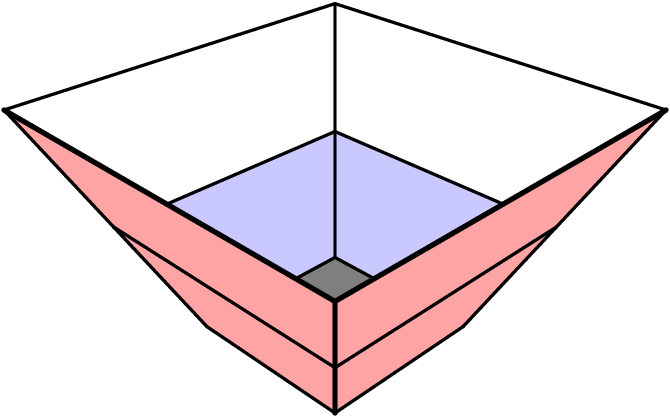
How many more minutes will it take to fill the remainder of the container?
Show solution without answering
Key insight
Extend the slanted sides to a point: the container is a pyramid with its tip cut off, and volume below a square of side s grows like s³.
Solution
- See the pyramid. The bottom is and the top is , and the four slanted sides are the same. Slice the container level with the ground at any height: you get a square, and its side grows steadily from at the bottom to at the top. If you kept the slanted sides going downward, the square would shrink to a point. So the container is a big square pyramid (tip pointing down) with a small pyramid cut off the bottom.
- How volume grows in a pyramid. Pyramids of the same shape scale in every direction. If one pyramid's square top has side twice as long as another's, it is also twice as tall, so its volume is times as big. In general, the volume from the tip up to a square of side is some fixed number times . Call that fixed number , so the volume is .
3. The three levels that matter.
- Bottom of the container: side , volume below it .
- The midline, halfway up: the side is halfway between and , which is . Volume below it: .
- Top: side , volume below it .
4. Water in each half of the container.
- Lower half: .
- Upper half: .
5. Convert to time. The hose runs at a steady rate. The lower half, , took minutes, so each takes minutes. The upper half needs
The answer is .
Why this works
A container with a flat bottom that widens evenly is a pyramid (or cone) with its tip cut off. Putting the tip back lets you use one rule: volume grows like the cube of the size. You never need the height or the constant , only the side lengths , , and their cubes. The same idea answers "how full is a cone-shaped cup filled to half its depth?"
Alternative approach
Use the formula for a pyramid with its tip cut off: volume , where and are the two square areas and is the height. Each half has the same height .
- Lower half, areas and : .
- Upper half, areas and : .
The ratio is again, so the time is minutes.
Concise solution
A shorter write-up, the way contest solutions are usually written. It may take a different route from the solution above.
The four sides are congruent trapezoids joining a square to a concentric square, so the horizontal cross-section at height is a square whose side grows linearly from at the bottom to at the top. Extending the four faces downwards, the side length shrinks to at a single point: the container is the part of a square pyramid lying between the cross-sections of side and side .
For that pyramid, the portion below the cross-section of side is similar to the whole pyramid with ratio , so its volume is
for some constant .
Three levels matter. The bottom is . The midline of a trapezoid is the segment joining the midpoints of its legs, so filling "up to the midline" means filling to half the height of the container, where the side is the average . The top is . Hence
- water poured so far: ,
- water still to come: .
The hose runs at a constant rate, so time is proportional to volume: takes minutes, i.e. minutes per unit of , and the remaining takes
The answer is .
Review in the AoPS books
- Introduction to Geometry, Chapter 14: Three-Dimensional Geometry
- Introduction to Algebra, Chapter 6: Ratios and Percents
- Introduction to Geometry, Chapter 19: Problem Solving Strategies in Geometry (§19.1)
- Introduction to Geometry, Chapter 4: Perimeter and Area (§4.2, §4.3)
Similar problems
Problem © Mathematical Association of America (MAA), American Mathematics Competitions. Reproduced for non-commercial educational use. Solution and commentary are original to this site.