2023 AMC 10B Problem 20
Four congruent semicircles are drawn on the surface of a sphere with radius , as shown, creating a close curve that divides the surface into two congruent regions. The length of the curve is . What is ?
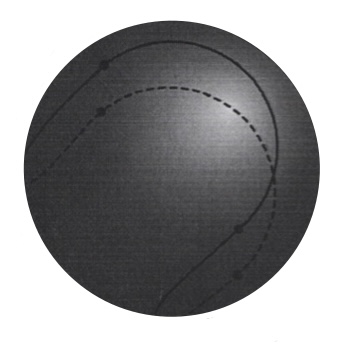
Show solution without answering
Key insight
The four corners where the semicircles meet are evenly spaced around the sphere's equator. Neighboring corners are 2 times root 2 apart, so each semicircle has radius root 2.
Solution
The curve is like the seam on a tennis ball. The main job is to find the size of one semicircle.
1. Where the semicircles meet. Call the four meeting points . The four semicircles are the same size and the curve splits the sphere into two matching halves, so the picture is evenly balanced: the four meeting points sit on the sphere's "equator" (a circle of radius around the center), a quarter turn apart. The semicircles bulge up and down in turn.
2. Distance between neighboring points. Take the center and two neighboring points , . Then (radii) and the angle at is (a quarter turn). By Pythagoras,
3. Size of one semicircle. Each semicircle has two neighboring meeting points as the ends of its diameter. So its diameter is and its radius is .
4. Length of one semicircle. Half of a full circle's length :
5. Total. Four of them:
So .
(Check that such a semicircle fits on the sphere. The middle of is from . A flat slice of the sphere at distance from the center is a circle of radius , the same size as our semicircle. So it lies on the sphere.)
The answer is .
Why this works
A circle drawn on a sphere is still an ordinary flat circle, so all you need is the distance between its endpoints. Turning the words "congruent" and "divides into two congruent regions" into a balanced picture with the meeting points a quarter turn apart is the key step; after that, one right triangle gives everything.
Concise solution
A shorter write-up, the way contest solutions are usually written. It may take a different route from the solution above.
Let the four points where consecutive semicircles meet be . Since the semicircles are congruent and the curve splits the sphere into two congruent pieces (like the seam of a tennis ball), the picture has fourfold symmetry about an axis through the center: the four junction points lie on a great circle, spaced apart, and the semicircles bulge alternately to one side and the other.
Each semicircle joins two adjacent junction points and, being a semicircle, has that segment as its diameter. The chord between adjacent points on a great circle of radius subtending has length : it is the hypotenuse of the right isosceles triangle formed with the center, whose legs are radii of length . So each semicircle has radius and length .
Check that such a semicircle really lies on the sphere: the plane circle with that diameter has center at distance from the sphere's center, and the sphere's section by any plane at distance is a circle of radius , matching.
Total length: , so .
The answer is .
Review in the AoPS books
- Introduction to Geometry, Chapter 14: Three-Dimensional Geometry
- Introduction to Geometry, Chapter 11: Circles
- Introduction to Algebra, Chapter 22: Special Manipulations (§22.3)
- Introduction to Geometry, Chapter 19: Problem Solving Strategies in Geometry (§19.1)
Similar problems
Problem © Mathematical Association of America (MAA), American Mathematics Competitions. Reproduced for non-commercial educational use. Solution and commentary are original to this site.