2025 AMC 10B Problem 20
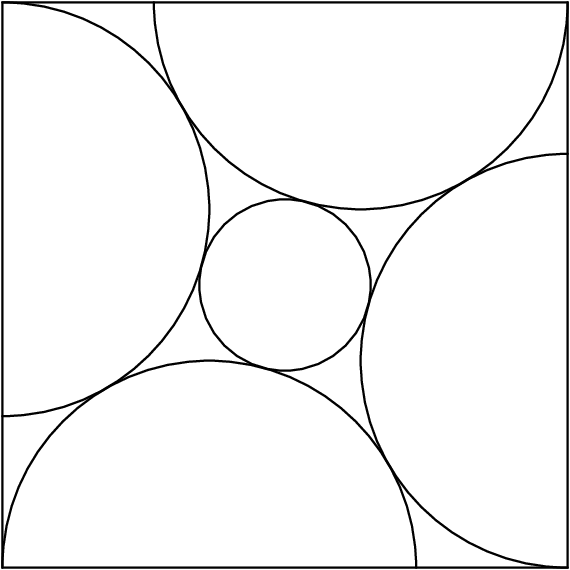
Four congruent semicircles are inscribed in a square of side length so that their diameters are on the sides of the square, one endpoint of each diameter is at a vertex of the square, and adjacent semicircles are tangent to each other. A small circle centered at the center of the square is tangent to each of the four semicircles, as shown below. The diameter of the small circle can be written as , where , , , and are integers. What is ?
Show solution without answering
Key insight
The four semicircle centers form a square of side 2r around the center, so each is r√2 from the center, and the small circle's radius is r√2 − r.
Solution
1. Set up coordinates. Put the square's corners at , , , . Let be the radius of each semicircle, so each diameter is long. Going around the square, the diameters start at the corners one after another:
- bottom side, from to , center ;
- right side, from to , center ;
- top side, center ;
- left side, center .
2. Find . Two touching circles of radius have centers apart. So the distance from to is . Going from to is across and up, so by the Pythagorean theorem
Multiply out: , so . The quadratic formula gives
(The other root is negative.)
- The centers form a square. Turn the whole picture a quarter turn about the center of the square. Each semicircle lands on the next one, so are all the same distance from and a quarter turn apart. They are the corners of a square centered at , with side .
4. Distance from to a center. In a square, the center is half a diagonal from each corner. The diagonal of a square of side is , so
5. The small circle. It sits in the middle and touches each semicircle from the outside. So the distance is its radius plus :
6. The diameter.
To match , take , , , . Then
The answer is .
Why this works
"Touching circles" always means "distance between centers equals the sum of the radii", so every tangency here is one Pythagorean equation. The symmetry of the picture (a quarter turn brings it back to itself) shows the four centers form a square, which gives the distance from the middle without any messy square roots. The problem only says are integers, so be ready for negative values when a length is a difference like .
Alternative approach
Skip the square and compute directly. From to :
From step 2, , so , and . Since , we get , the same as before.
Concise solution
A shorter write-up, the way contest solutions are usually written. It may take a different route from the solution above.
Put the square at and let be the common radius of the semicircles. Reading the figure, the four diameters follow each other round the square: one runs from to , the next from to , and so on. Their centres are
Finding . Adjacent semicircles are tangent and neither contains the other, so :
Finding the small radius. A rotation about the centre of the square carries the whole picture to itself and sends . So is a square centred at , and its side is the tangency distance . A square of side has circumradius , so
The small circle, of radius , sits between the four arcs and touches each from outside, so and
Therefore the diameter is
so , , , (or the two factors swapped), and
The answer is .
Review in the AoPS books
- Introduction to Geometry, Chapter 11: Circles
- Introduction to Geometry, Chapter 17: Analytic Geometry
- Introduction to Algebra, Chapter 22: Special Manipulations (§22.3)
- Introduction to Geometry, Chapter 12: Circles and Angles
Similar problems
Problem © Mathematical Association of America (MAA), American Mathematics Competitions. Reproduced for non-commercial educational use. Solution and commentary are original to this site.