A container has a square bottom, a open square top, and four congruent trapezoidal sides, as shown. Starting when the container is empty, a hose that runs water at a constant rate takes minutes to fill the container up to the midline of the trapezoids.
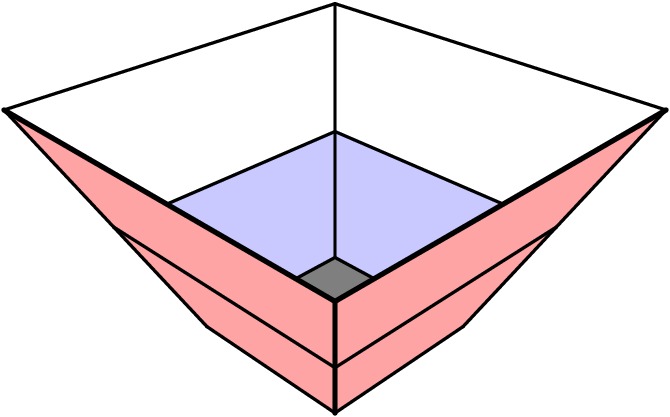
How many more minutes will it take to fill the remainder of the container?
- A)
- B)
- C)
- D)
- E)
Answer
D
Key insight
Extend the four trapezoids to their common apex: the container is part of a square pyramid, where volume below a cross-section of side s scales as s^3.
Solution
The four sides are congruent trapezoids joining a square to a concentric square, so the horizontal cross-section at height is a square whose side grows linearly from at the bottom to at the top. Extending the four faces downwards, the side length shrinks to at a single point: the container is the part of a square pyramid lying between the cross-sections of side and side .
For that pyramid, the portion below the cross-section of side is similar to the whole pyramid with ratio , so its volume is
for some constant .
Three levels matter. The bottom is . The midline of a trapezoid is the segment joining the midpoints of its legs, so filling "up to the midline" means filling to half the height of the container, where the side is the average . The top is . Hence
- water poured so far: ,
- water still to come: .
The hose runs at a constant rate, so time is proportional to volume: takes minutes, i.e. minutes per unit of , and the remaining takes
The answer is .
Why this works
Every frustum question becomes easy once the missing tip is restored, because a pyramid or cone has the one-line scaling law and differences of cubes then replace any volume formula. Nothing about the actual height, or the value of , is ever needed — only the three side lengths . The same idea answers "what fraction of a conical cup is filled to half its depth", and it is the reason a frustum's two halves are so unequal.
Alternative approach
Use the frustum formula directly, with the height of each half. The lower half joins areas and :
and the upper half joins areas and :
The ratio is again , giving .
The trap
Assuming that filling to half the height fills half the container, so the rest takes about the same 35 minutes again and a guess is pushed toward the 70 in (A).
Common mistakes
- Assuming that filling to half the height fills half the container, so the rest takes about the same 35 minutes again and a guess is pushed toward the 70 in (A).
- Taking the cross-section at the midline to have area (the average of the end areas) instead of (the square of the average side).
- Scaling volumes by rather than , which gives a ratio of and no listed answer.
Techniques
Add construction lines/points (drop altitudes, extend segments, connect centers) · Cut the figure into known shapes (triangles, rectangles, sectors)