2022 AMC 10A Problem 21
A bowl is formed by attaching four regular hexagons of side to a square of side . The edges of the adjacent hexagons coincide, as shown in the figure. What is the area of the octagon obtained by joining the top eight vertices of the four hexagons, situated on the rim of the bowl? 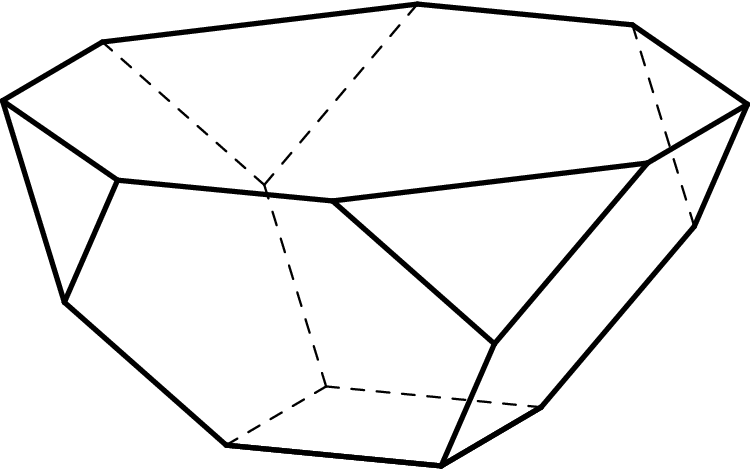
Show solution without answering
Key insight
The rim is level, so its area equals its shadow seen from above. A shared hexagon edge shows each top edge sits 1 unit outside the square.
Solution
Step 1: look from above. Put the square flat, with corners , , , . The four hexagons are placed the same way on the four sides, so they all lean by the same amount. Each hexagon's top edge is parallel to its bottom edge, which is level, so all eight rim points are at the same height. The octagon is therefore level, and its area equals the area of its shadow straight down. So we only need where the rim points are when seen from above.
Step 2: facts about one hexagon, laid flat. Put a regular hexagon of side with its bottom edge from to . Its other corners are , , , . So the corner next to the bottom edge sits past the end of the edge and "up the hexagon", and the top edge is directly above the bottom edge, up the hexagon.
Step 3: find one corner that two hexagons share. Call the hexagon on side to the front one, and the hexagon on side to the right one. They share the edge that rises from the square's corner to a point .
- The front hexagon's bottom edge runs in the direction, so is past in that direction: from above, has .
- The right hexagon's bottom edge runs in the direction from down to , so is past : from above, has .
So from above, is at .
Step 4: how much the lean shrinks things. In the front hexagon, is up the hexagon, and from above that shows up as moving outward from to , that is, by . The hexagon is a flat tilted sheet, so every distance "up the hexagon" shrinks by the same factor. The top edge is up, twice as far as , so from above it is outward. The front top edge appears as the segment from to .
Step 5: all four top edges. By symmetry, from above the top edges are
The other four sides of the octagon join neighboring ones, such as to .
Step 6: area. The shadow is the square with corners and , with a right triangle with legs and cut off at each corner:
The answer is .
Why this works
A symmetric 3D shape is often easiest to measure from a well-chosen view. The rim is level, so the top view shows its true area. The only unknown was how much the hexagons lean, and the edge shared by two neighboring hexagons pins that down with no trigonometry: seen from one hexagon it gives the -coordinate, from the other the -coordinate.
Alternative approach
A check that the picture makes sense: is unit from the corner , and from above it has moved in and in . By the Pythagorean theorem its height is , so the hexagons really do lean outward, as a bowl should.
Concise solution
A shorter write-up, the way contest solutions are usually written. It may take a different route from the solution above.
Put the square in the horizontal plane with corners , , , . By the square's symmetry all four hexagons tilt equally, so the eight rim vertices are at one common height: the octagon is horizontal, and its area equals the area of its top view.
Look at hexagon on the side from to and hexagon on the side from to . They share the edge rising from the corner to a vertex . In a regular hexagon of side , the vertex adjacent to one end of a side lies farther along that side's direction and away perpendicular to it, within the hexagon's plane. The plane of contains the -direction, so has -coordinate ; the plane of contains the -direction, so has -coordinate . Thus the in-plane perpendicular offset in projects to a horizontal offset of exactly outward (from to ).
The top edge of is at in-plane distance from its base edge, so it projects twice as far: seen from above it runs from to . By symmetry the four top edges project to -, -, -, -, and the other four rim edges join consecutive ones, such as -.
The octagon is therefore the square with corners , , , with four isosceles right triangles of legs cut off:
The answer is .
Review in the AoPS books
- Introduction to Geometry, Chapter 14: Three-Dimensional Geometry
- Introduction to Geometry, Chapter 8: Quadrilaterals
- Introduction to Geometry, Chapter 2: Angles
- Introduction to Geometry, Chapter 17: Analytic Geometry (§17.4, §17.6)
Similar problems
Problem © Mathematical Association of America (MAA), American Mathematics Competitions. Reproduced for non-commercial educational use. Solution and commentary are original to this site.