2011 AMC 10B Problem 16
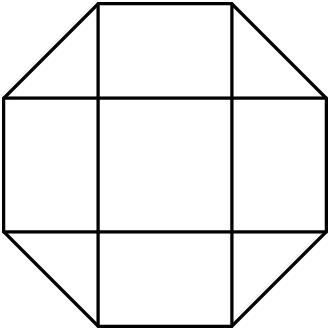
A dart board is a regular octagon divided into regions as shown. Suppose that a dart thrown at the board is equally likely to land anywhere on the board. What is the probability that the dart lands within the center square?
Show solution without answering
Key insight
Let the octagon's side be the square root of 2. The corner triangles then have legs 1, and the octagon is a square minus four corners.
Solution
The dart is equally likely to land anywhere, so the probability is (area of the center square) divided by (area of the octagon). Any side length gives the same ratio, so pick one that makes the numbers easy.
1. Choose a size. Let each side of the octagon be . The four corner pieces are right triangles with two equal legs, and their longest side is an octagon side, . A right triangle with legs and has longest side , so each leg is .
2. The center square. Its sides are the same length as the octagon's sides, . So its area is .
3. The octagon. Extend the octagon's corners into a big square. Each side of the big square is a leg, then an octagon side, then a leg: . Its area is
4. The octagon is this big square minus four corner triangles, each with area :
5. The probability.
6. None of the choices looks like this, so remove the square root from the bottom. Multiply top and bottom by , using :
The answer is .
Why this works
A regular octagon is a square with its four corners cut off, and the cut-off corners are right triangles with two equal legs. Choosing the side length so those legs are makes every area easy. With an evenly thrown dart, probability is just a ratio of areas.
Alternative approach
Add up all nine regions instead. With side : the center square has area ; the four rectangles along the sides are each by , total ; the four corner triangles have total area . The octagon's area is , the same as before.
Concise solution
A shorter write-up, the way contest solutions are usually written. It may take a different route from the solution above.
Let the octagon have side , chosen so the corner pieces have nice legs. The four corner regions are isosceles right triangles whose hypotenuse is an octagon side, so each has legs and area .
The dividing lines extend the sides of the center square out to the octagon, so the octagon sits inside a bounding square of side . The center square has side equal to the octagon's side, , hence area .
Octagon area bounding square minus four corner triangles:
The probability is
The answer is .
Review in the AoPS books
- Introduction to Counting & Probability, Chapter 10: Geometric Probability
- Introduction to Geometry, Chapter 8: Quadrilaterals
- Introduction to Geometry, Chapter 4: Perimeter and Area (§4.2, §4.3)
- Introduction to Geometry, Chapter 9: Polygons (§9.3)
Similar problems
Problem © Mathematical Association of America (MAA), American Mathematics Competitions. Reproduced for non-commercial educational use. Solution and commentary are original to this site.