2011 AMC 10B Problem 17
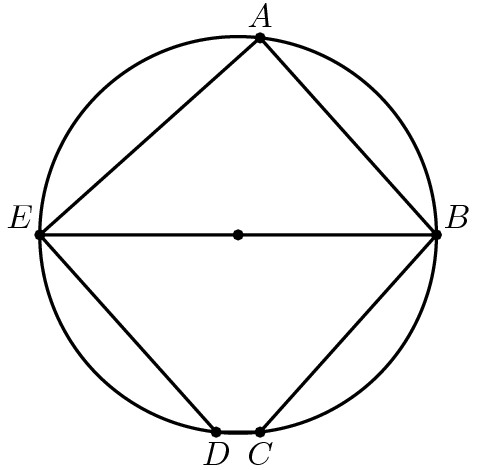
In the given circle, the diameter is parallel to , and is parallel to . The angles and are in the ratio . What is the degree measure of angle ?
Show solution without answering
Key insight
Angle A is 90 degrees because EB is a diameter, so angle ABE is 50. Parallel lines copy that 50 to angle BED, and angle BCD is 180 minus 50.
Solution
Work from the top triangle down to , one angle at a time.
1. Triangle . is a diameter, and any angle drawn from a diameter to a point on the circle is a right angle. So .
2. The other two angles of triangle add to degrees, in the ratio . Split into equal parts of : and .
3. Move the down. is parallel to , and crosses both. The angles (above ) and (below ) are alternate angles, so they are equal: .
4. The bottom shape is symmetric. has parallel to , and all four corners are on the circle. A shape like this is the same on its left and right halves (fold it along the line through the center perpendicular to ). So .
5. Finish with the parallel lines. is parallel to , and crosses both. The two angles on the same side, and , add to . So
The answer is .
Why this works
Three facts are chained together: an angle standing on a diameter is ; parallel lines let you copy an angle to a new spot; and a four-sided shape inside a circle with two parallel sides is symmetric. In circle problems, look for a diameter first, because it hands you a right angle for free.
Alternative approach
Once you know , use the rule for a four-sided shape with all corners on a circle: opposite angles add to . In , the angles at and are opposite, so .
Concise solution
A shorter write-up, the way contest solutions are usually written. It may take a different route from the solution above.
Since is a diameter, . The other two angles of triangle sum to in ratio , so and .
Because with transversal , alternate interior angles give .
Points lie on the circle in that order (with , the chord sits on one side of the diameter and is between and along the arc). So is a cyclic quadrilateral, and its opposite angles at and are supplementary:
The answer is .
Review in the AoPS books
- Introduction to Geometry, Chapter 11: Circles
- Introduction to Geometry, Chapter 2: Angles
- Introduction to Geometry, Chapter 12: Circles and Angles
- Introduction to Geometry, Chapter 9: Polygons (§9.1, §9.2)
Similar problems
Problem © Mathematical Association of America (MAA), American Mathematics Competitions. Reproduced for non-commercial educational use. Solution and commentary are original to this site.