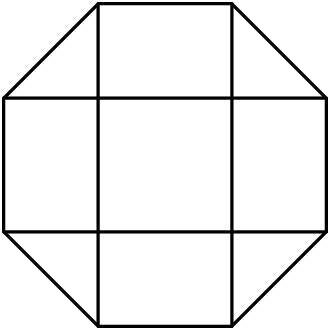
A dart board is a regular octagon divided into regions as shown. Suppose that a dart thrown at the board is equally likely to land anywhere on the board. What is the probability that the dart lands within the center square?
- A)
- B)
- C)
- D)
- E)
Answer
A
Key insight
With octagon side s, the center square also has side s, and the octagon is a square of side s(1 + sqrt 2) minus four corner triangles.
Solution
Let the octagon have side , chosen so the corner pieces have nice legs. The four corner regions are isosceles right triangles whose hypotenuse is an octagon side, so each has legs and area .
The dividing lines extend the sides of the center square out to the octagon, so the octagon sits inside a bounding square of side . The center square has side equal to the octagon's side, , hence area .
Octagon area bounding square minus four corner triangles:
The probability is
The answer is .
Why this works
A regular octagon is a square with its corners cut off, and the cut corners are -- triangles. Choosing the side length so those triangles have integer legs makes every region's area immediate. Uniform darts turn "probability" into "area ratio."
Alternative approach
Tally the nine regions with side : the center square (), four rectangles ( total), and four triangles ( total). Total , same ratio.
The trap
Forgetting to subtract the four corner triangles from the bounding square, or leaving the answer as 1/(2 + 2 sqrt 2) without rationalizing to match a choice.
Common mistakes
- Forgetting to subtract the four corner triangles from the bounding square, or leaving the answer as without rationalizing to match a choice.
- Using the wrong triangle leg (taking the leg equal to the side rather than side), which produces choice (E) or (C).
Techniques
Cut the figure into known shapes (triangles, rectangles, sectors)