2021 AMC 10B Problem 23
A square with side length is colored white except for black isosceles right triangular regions with legs of length in each corner of the square and a black diamond with side length in the center of the square, as shown in the diagram. A circular coin with diameter is dropped onto the square and lands in a random location where the coin is completely contained within the square. The probability that the coin will cover part of the black region of the square can be written as , where and are positive integers. What is ? 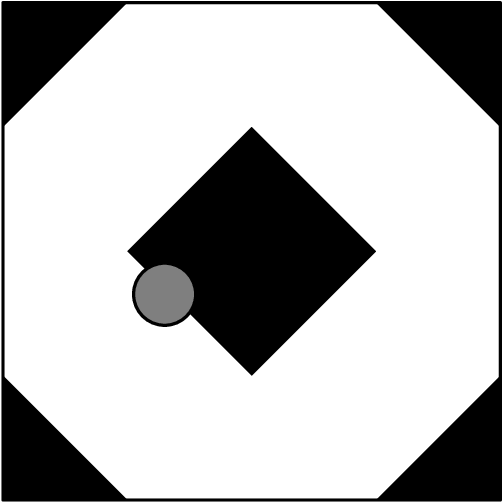
Show solution without answering
Key insight
Follow the coin's center. It lands in a 7 by 7 square, and the coin touches black exactly when the center is within 1/2 of a black shape.
Solution
Step 1: follow the center of the coin.
- The coin has radius . It stays inside the square exactly when its center is at least from every side. So the center lands anywhere in a smaller square, with area . This is our "all possible outcomes" area.
- The coin touches a black shape exactly when its center is within of that shape. So we need the area of all such center points (call it the bad area), and the probability is bad area .
- Place the square with corners and , so the center can be anywhere with and from to .
Step 2: the diamond.
4. The diamond has side , so its diagonals are and its area is . Its perimeter is .
5. The points within of the diamond are made of three parts:
- the diamond itself: ;
- a strip of width along each of the four sides: ;
- rounded pieces at the four corners. Together these four pieces make one whole circle of radius : area .
6. Bad area near the diamond: .
Step 3: one corner triangle.
7. Look at the triangle at the corner , with vertices , , . Its slanted side lies on the line .
8. The center always has and , so it is never too close to the two short sides of the triangle. Only the slanted side matters.
9. Moving from the line straight away from it by a distance of reaches the line . (Moving by in the slanted direction adds to each of and , so grows by .)
10. So the bad points here are those with and . That is a right triangle with its corner at and two equal legs of length .
11. Its area is
12. Four corners: .
Step 4: put it together.
13. These regions do not overlap (the diamond's region stays near the middle). Total bad area:
14. Divide by :
15. So , , and .
The answer is .
Why this works
A coin is hard to track, but its center is a single point. "The coin stays inside" shrinks the square, and "the coin touches black" grows each black shape by the radius. Growing a shape adds strips along its sides plus rounded corners that make one full circle, which is where the comes from. The corner triangles are different because the center cannot get close to the square's edges, so only their slanted sides count.
Concise solution
A shorter write-up, the way contest solutions are usually written. It may take a different route from the solution above.
The coin has radius , so its center is uniformly distributed over the square of points at least from every side (area ). The coin touches black exactly when its center is within of a black region. We find the area of that "bad" set.
Diamond. The diamond is a square with diagonals and , area , perimeter . Points within of a convex polygon form the polygon, plus a strip of width along each side, plus quarter-discs at the vertices that together make one full disc of radius :
Corner triangles. Take the corner at the origin: the triangle with vertices . Allowed centers have , so they are already at least from the two legs; only the hypotenuse matters. A center is within of it when . The bad set is the right isosceles triangle with vertex and legs :
Four corners: .
Total. Bad area , so the probability is
Hence .
The answer is .
Review in the AoPS books
- Introduction to Counting & Probability, Chapter 10: Geometric Probability
- Introduction to Geometry, Chapter 8: Quadrilaterals
- Introduction to Geometry, Chapter 11: Circles
- Introduction to Geometry, Chapter 4: Perimeter and Area (§4.2, §4.3)
Similar problems
Problem © Mathematical Association of America (MAA), American Mathematics Competitions. Reproduced for non-commercial educational use. Solution and commentary are original to this site.