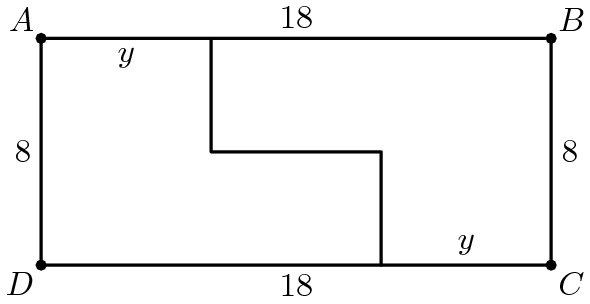
The rectangle is cut into two congruent hexagons, as shown, in such a way that the two hexagons can be repositioned without overlap to form a square. What is ?
- A)
- B)
- C)
- D)
- E)
Answer
A
Key insight
Rearranging pieces preserves area, so the square has side 12; the long edge 18 − y of each hexagon must become a full side of that square.
Solution
Cutting and moving pieces never changes total area, so the square has area and side .
Now read the figure. The cut goes down (half the height), across, and down again. The left hexagon has a short top edge of length and a long bottom edge running from to the foot of the cut, of length ; the right hexagon is the same piece turned around, with a long top edge and short bottom edge .
To build the square, slide the right hexagon up by and left so that the two steps interlock. The stacked heights match the square, and the two long edges become the top and bottom sides of the square. Hence
Consistency check: the middle horizontal segment of the cut has length , so the two short edges fit exactly into the notches, as a square with no gaps requires.
The answer is .
Why this works
Dissection problems almost always start with the invariant: area. That fixes the target shape's dimensions, after which one labeled edge of a piece matched against a side of the target gives an equation. Verify with a second edge to be sure the pieces really interlock.
Alternative approach
The horizontal is made of three pieces that must be interchangeable for the hexagons to nest: the two labeled segments and the middle segment of the cut. Interlocking forces the middle segment to equal too, so and .
The trap
Eyeballing y from the drawing, or assuming y is half of 18 or of 12, instead of first finding the square's side from the area 144.
Common mistakes
- Eyeballing from the drawing, or assuming is half of or of , instead of first finding the square's side from the area .
- Forgetting the pieces have height with a step of , and trying to make the square tall.
Techniques
Set up the equation/formula and compute; no special trick needed · Use an invariant, parity, or coloring argument