2003 AMC 10A Problem 10
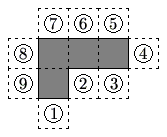
The polygon enclosed by the solid lines in the figure consists of 4 congruent squares joined edge-to-edge. One more congruent square is attached to an edge at one of the nine positions indicated. How many of the nine resulting polygons can be folded to form a cube with one face missing?
Show solution without answering
Key insight
Fold the four solid squares first. They make a bottom and three walls, so a fifth square works exactly when it folds onto one of the two faces still missing.
Solution
Folding nine different shapes separately is hard to keep straight. All nine share the same four squares, so fold those first and see what is still missing.
1. The four solid squares form an L: three squares in a row, plus one more attached to the side of an end square.
2. Fold them into part of a cube. Let the middle square of the row be the bottom. Its two neighbors in the row fold up into two opposite walls; call them front and back. The extra square, attached to the front wall, folds around to become the right wall.
3. So the four squares make the bottom, front, back and right. A cube has faces, and a cube with one face missing has . The faces still absent are the left wall and the top. The new square must fill one of these two; then the other one is the missing face.
4. A new square attached along an edge folds onto the face of the cube on the far side of that edge. Count the free edges that point at each missing face:
- The left wall touches the bottom, front and back. Each of those three squares has one free edge on the left side. That is good positions.
- The top touches the front, back and right. Each of those has one free edge along the top rim. That is more good positions.
5. The other positions fold onto a face that is already there (the front, back or right), so the squares overlap and the shape fails.
That gives good positions.
The answer is .
Why this works
Instead of testing nine nets one by one, fold the part they all share once and ask which faces are still empty. Each free edge of a half-folded box points at exactly one face, so counting good positions becomes counting edges next to the empty faces. The same trick works for any "add one square to this net" problem.
Concise solution
A shorter write-up, the way contest solutions are usually written. It may take a different route from the solution above.
The four solid squares form an L: three squares in a line with a fourth attached to the side of an end square. Fold these four first. The middle square of the line is the bottom of the box; its two neighbors fold up to become two opposite walls (call them front and back); the fourth square, hanging off the front wall, wraps around to become the right wall. The result is a box missing exactly two faces: the left wall and the top.
Now attach the fifth square along a free edge. When the net folds, that square lands on the face of the cube that lies across that edge. The attachment succeeds precisely when that face is one of the two missing ones.
- The left wall shares an edge with the bottom, the front wall and the back wall. Each of those three squares has one free edge on its left side, so positions produce the left wall.
- The top shares an edge with the front, back and right walls. Each of these has exactly one free edge that becomes its top rim, so positions produce the top.
That is working positions. The other three (the square filling the inner corner of the L, and the two that fold onto the already-present right or back wall) create overlaps.
The answer is .
Review in the AoPS books
- Introduction to Geometry, Chapter 14: Three-Dimensional Geometry
- Introduction to Geometry, Chapter 16: The More Things Change. . . (§16.1, §16.2, §16.3, §16.4)
- Intermediate Counting & Probability, Chapter 4: Constructive Counting and 1-1 Correspondences (§4.4, §4.5, §4.6)
- Prealgebra, Chapter 15: Problem-Solving Strategies (§15.2)
Similar problems
Problem © Mathematical Association of America (MAA), American Mathematics Competitions. Reproduced for non-commercial educational use. Solution and commentary are original to this site. Also appeared as 2003 12A #13.