2018 AMC 10B Problem 15
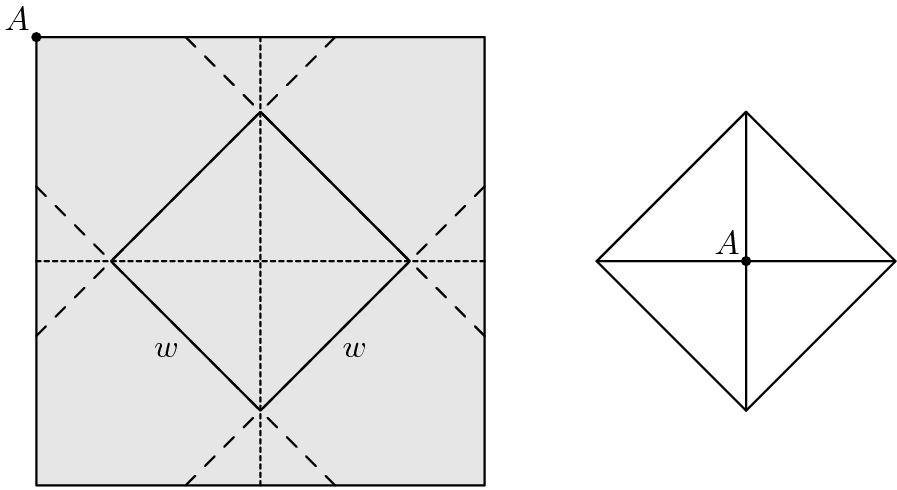
A closed box with a square base is to be wrapped with a square sheet of wrapping paper. The box is centered on the wrapping paper with the vertices of the base lying on the midlines of the square sheet of paper, as shown in the figure on the left. The four corners of the wrapping paper are to be folded up over the sides and brought together to meet at the center of the top of the box, point in the figure on the right. The box has base length and height . What is the area of the sheet of wrapping paper?
Show solution without answering
Key insight
Follow the paper from its center to a corner: half the width across the bottom, up the side, half the width on top. That is w plus h.
Solution
Folding paper does not stretch it, so a straight line on the flat sheet keeps its length after folding. Follow one well-chosen line.
1. Pick the line. Draw the line from the center of the sheet to one of its corners. This is half of the sheet's diagonal.
2. Across the bottom. The box is turned so its corners lie on the sheet's midlines. Then the line toward a corner of the sheet hits the middle of one side of the base, straight on. The center of the base to the middle of a side is half the side: .
3. Up the side. The paper folds up the side face. The line was straight on to the bottom edge, so it goes straight up the face: length .
4. Across the top. The paper folds again over the top edge and runs straight in to the center of the top, point , where the corner ends up. That is another .
5. Half the diagonal.
So the whole diagonal of the sheet is .
6. Area from the diagonal. A square with diagonal has area (it is two right triangles with base and height ). So
The answer is .
Why this works
A path on the flat paper becomes a chain of straight pieces on the box, and folding keeps every length. Choosing a path that crosses every fold straight on (here the diagonal) makes each piece easy to measure. For a square, knowing the diagonal is enough to get the area.
Alternative approach
Test an extreme case. Let the box become a very thin pole, , of height . Each corner of the sheet must reach the top of the pole, so half the diagonal is and the area is . Put into the choices: (A) gives , (B) gives , and (C), (D), (E) all give . Only (A) fits.
Concise solution
A shorter write-up, the way contest solutions are usually written. It may take a different route from the solution above.
Follow one diagonal of the sheet from its center out to a corner . The box's base is tilted relative to the sheet, so this diagonal is perpendicular to one side of the base and crosses that side at its midpoint, a distance from .
From there the paper folds up that side face. The diagonal stays perpendicular to the bottom edge, so it climbs straight up the face: length . At the top edge it folds again and runs along the top face, perpendicular to that edge, until the corner lands on the top's center : another .
Hence the half-diagonal of the sheet is
so the full diagonal is . A square with diagonal has area :
The answer is .
Review in the AoPS books
- Introduction to Geometry, Chapter 14: Three-Dimensional Geometry
- Introduction to Geometry, Chapter 16: The More Things Change. . . (§16.1, §16.2, §16.3, §16.4)
- Introduction to Geometry, Chapter 19: Problem Solving Strategies in Geometry (§19.1)
- Introduction to Geometry, Chapter 15: Curved Surfaces
Similar problems
Problem © Mathematical Association of America (MAA), American Mathematics Competitions. Reproduced for non-commercial educational use. Solution and commentary are original to this site.