2021 AMC 10A Problem 12
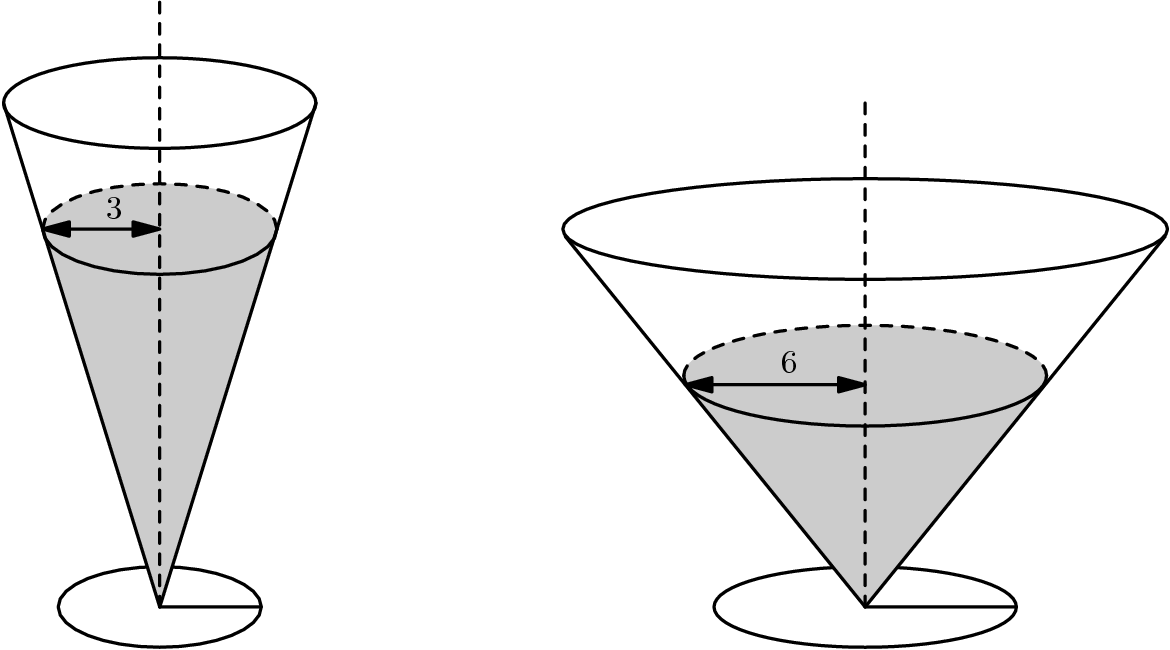
Two right circular cones with vertices facing down as shown in the figure below contain the same amount of liquid. The radii of the tops of the liquid surfaces are and . Into each cone is dropped a spherical marble of radius , which sinks to the bottom and is completely submerged without spilling any liquid. What is the ratio of the rise of the liquid level in the narrow cone to the rise of the liquid level in the wide cone?
Show solution without answering
Key insight
Equal volumes make the narrow cone's liquid 4 times as deep. Equal marbles stretch both depths by the same factor, so the rises stay 4 to 1.
Solution
1. The liquid in each cone fills a smaller cone with the same shape as the container: a depth, and a round top.
2. A cone's volume is . The narrow liquid has top radius and some depth ; the wide liquid has top radius and depth . Equal volumes give
With real numbers: a wide depth of cm and a narrow depth of cm both give volume .
3. A useful fact about cones of the same shape: if you make the cone times as tall, the top radius also becomes times as big, so the volume becomes times as big.
4. Dropping in a marble raises the level as if the liquid had grown by the marble's volume . Both cones start with the same volume and both gain the same , so both volumes are multiplied by the same number: . (A different starting amount would give a different number, but it would still be the same for both cones, since they start equal and gain equal amounts.)
5. By step 3, both depths are then multiplied by the same number (the number with , about ). We never need its exact value.
6. The narrow cone goes from depth to , a rise of . The wide cone goes from to , a rise of .
7. The ratio of the rises is .
The answer is .
Why this works
Liquid in a point-down cone always makes a copy of the cone, so its depth depends only on its volume. Two situations that start with the same volume and gain the same volume get stretched by the same factor, so the rises keep the same ratio as the starting depths. That is why the marble's actual size drops out.
Concise solution
A shorter write-up, the way contest solutions are usually written. It may take a different route from the solution above.
Let the liquid heights be (narrow cone, radius ) and (wide cone, radius ). Equal volumes give
Each body of liquid is itself a cone similar to its container, so its volume is proportional to the cube of its height. After the marble is added, both liquids have the same new volume , so both volumes grow by the same factor , and both heights grow by the same factor .
The rises are and , whose ratio is
The answer is .
Review in the AoPS books
- Introduction to Geometry, Chapter 14: Three-Dimensional Geometry
- Introduction to Geometry, Chapter 3: Congruent Triangles
- Introduction to Algebra, Chapter 22: Special Manipulations (§22.3)
- Introduction to Geometry, Chapter 15: Curved Surfaces
Similar problems
Problem © Mathematical Association of America (MAA), American Mathematics Competitions. Reproduced for non-commercial educational use. Solution and commentary are original to this site.