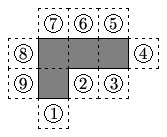
The polygon enclosed by the solid lines in the figure consists of 4 congruent squares joined edge-to-edge. One more congruent square is attached to an edge at one of the nine positions indicated. How many of the nine resulting polygons can be folded to form a cube with one face missing?
- A)
- B)
- C)
- D)
- E)
Answer
E
Key insight
Fold the four given squares first; they form a bottom and three walls, and a new square works exactly when it folds onto one of the two missing faces.
Solution
The four solid squares form an L: three squares in a line with a fourth attached to the side of an end square. Fold these four first. The middle square of the line is the bottom of the box; its two neighbors fold up to become two opposite walls (call them front and back); the fourth square, hanging off the front wall, wraps around to become the right wall. The result is a box missing exactly two faces: the left wall and the top.
Now attach the fifth square along a free edge. When the net folds, that square lands on the face of the cube that lies across that edge. The attachment succeeds precisely when that face is one of the two missing ones.
- The left wall shares an edge with the bottom, the front wall and the back wall. Each of those three squares has one free edge on its left side, so positions produce the left wall.
- The top shares an edge with the front, back and right walls. Each of these has exactly one free edge that becomes its top rim, so positions produce the top.
That is working positions. The other three (the square filling the inner corner of the L, and the two that fold onto the already-present right or back wall) create overlaps.
The answer is .
Why this works
Instead of testing nine nets separately, fold the common part once and reason about which faces are still absent. Each free edge of a partially folded box "points at" exactly one face, so counting good positions is counting edges adjacent to missing faces. This edge-to-face correspondence works for any net-completion problem.
The trap
Trying to fold all nine shapes from scratch in your head and losing track, or forgetting that the notch position touches two squares and doubles up.
Common mistakes
- Trying to fold all nine shapes from scratch in your head and losing track, or forgetting that the notch position touches two squares and doubles up.
- Assuming a cube missing one face needs a "cross" shape and rejecting valid nets such as a straight row of four squares plus one on the side.
Techniques
Map the objects to something easier to count · Organized listing / direct enumeration