2002 AMC 10A Problem 5
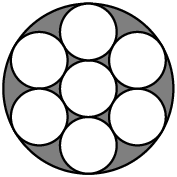
Each of the small circles in the figure has radius one. The innermost circle is tangent to the six circles that surround it, and each of those circles is tangent to the large circle and to its small-circle neighbors. Find the area of the shaded region.
Show solution without answering
Key insight
Along a line through the centers, the big radius is 1 + 2 = 3. Its area, 9 pi, minus seven small circles of area pi leaves 2 pi.
Solution
The shaded region is the big circle with the small circles cut out. So we need the big circle's radius, then we subtract.
1. Find the big radius. Draw a line from the center of the figure through the center of one of the outer small circles, out to the big circle. Walking along it from the center:
- through the middle small circle to its edge: ,
- straight across one outer small circle: its diameter, ,
- and now we are at the big circle, because that outer circle touches it.
So the big radius is .
- Big circle's area: .
- Small circles: there are of them (one in the middle, six around it), each of area . Together: .
4. Shaded area:
The answer is .
Why this works
When two circles touch, the line through their centers passes through the touching point, so lengths along that line simply add up. That turns the picture into a one-line measurement. The shaded region is then "big shape minus the pieces removed", the standard move for shaded-area problems.
Concise solution
A shorter write-up, the way contest solutions are usually written. It may take a different route from the solution above.
Draw a line through the center of the figure and the center of one surrounding circle. Along that line, from the big circle's center outward, we cross the radius of the central unit circle (), then the full diameter of a surrounding unit circle (), and arrive at the big circle. So the big radius is and its area is .
Seven unit circles (one in the middle, six around it) are removed, each of area . The shaded area is
The answer is .
Review in the AoPS books
- Introduction to Geometry, Chapter 11: Circles
- Introduction to Geometry, Chapter 4: Perimeter and Area (§4.2, §4.3)
- Introduction to Geometry, Chapter 12: Circles and Angles
- Introduction to Geometry, Chapter 13: Power of a Point
Similar problems
Problem © Mathematical Association of America (MAA), American Mathematics Competitions. Reproduced for non-commercial educational use. Solution and commentary are original to this site. Also appeared as 2002 12A #5.