2014 AMC 10A Problem 12
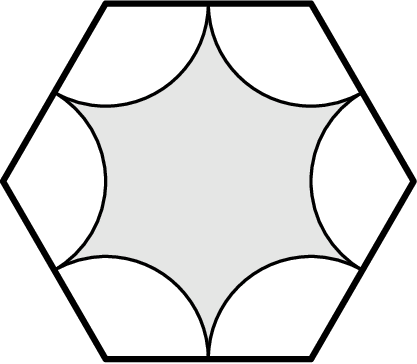
A regular hexagon has side length 6. Congruent arcs with radius 3 are drawn with the center at each of the vertices, creating circular sectors as shown. The region inside the hexagon but outside the sectors is shaded as shown. What is the area of the shaded region?
Show solution without answering
Key insight
Each sector opens as wide as the hexagon's corner, 120 degrees, which is one third of a circle. Six thirds make two whole circles of radius 3.
Solution
The shaded part is the hexagon with the six sectors taken out, so find the two areas and subtract.
The hexagon.
- A regular hexagon with side splits into six equilateral triangles with side by drawing lines from the center to each corner.
- An equilateral triangle with side has area . With that is .
- Six of them: .
The sectors.
- Each sector sits in a corner of the hexagon, between the two sides that meet there. So it opens exactly as wide as the corner angle.
- The corner angles of a hexagon add up to , so each corner is . That is of a full circle.
- A full circle of radius has area , so each sector has area . Six sectors: .
- The sectors do not overlap: the radius is half of a side, so two neighbouring sectors just meet at the middle of the side between them.
Shaded area. .
The answer is .
Why this works
"Inside the shape but outside the sectors" means subtract. The only thing to be careful about is the angle of each sector, which is the polygon's corner angle, not the angle at the center. A quick check: the six corner angles add to , which is exactly two full circles, so the sectors together make two circles of radius , area .
Concise solution
A shorter write-up, the way contest solutions are usually written. It may take a different route from the solution above.
Hexagon. A regular hexagon of side splits into six equilateral triangles of side , each of area . Total: .
Sectors. At each vertex the sector is bounded by the two sides meeting there, so its angle is the interior angle of the hexagon, , one third of a circle. Each sector has area . Six of them give . (Since the radius is half the side, neighboring sectors just touch at the midpoints of the sides and do not overlap.)
Shaded region. Subtract:
The answer is .
Review in the AoPS books
- Introduction to Geometry, Chapter 11: Circles
- Introduction to Geometry, Chapter 8: Quadrilaterals
- Introduction to Geometry, Chapter 2: Angles
- Introduction to Geometry, Chapter 4: Perimeter and Area (§4.2, §4.3)
Similar problems
Problem © Mathematical Association of America (MAA), American Mathematics Competitions. Reproduced for non-commercial educational use. Solution and commentary are original to this site.