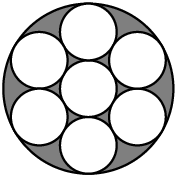
Each of the small circles in the figure has radius one. The innermost circle is tangent to the six circles that surround it, and each of those circles is tangent to the large circle and to its small-circle neighbors. Find the area of the shaded region.
- A)
- B)
- C)
- D)
- E)
Answer
C
Key insight
A diameter of the big circle passes through three unit circles in a row, so its radius is 3; subtract seven unit-circle areas from 9 pi.
Solution
Draw a line through the center of the figure and the center of one surrounding circle. Along that line, from the big circle's center outward, we cross the radius of the central unit circle (), then the full diameter of a surrounding unit circle (), and arrive at the big circle. So the big radius is and its area is .
Seven unit circles (one in the middle, six around it) are removed, each of area . The shaded area is
The answer is .
Why this works
When circles are tangent, their centers and the tangency point are collinear, so lengths add along a line through the centers. That turns the picture into a one-dimensional measurement (radius ). After that, the shaded region is simply a big circle minus several disjoint small circles.
The trap
Forgetting the central circle and subtracting only six small circles, which gives 3 pi.
Common mistakes
- Forgetting the central circle and subtracting only six small circles, which gives 3 pi.
- Taking the big radius to be (center to the center of a neighbor) instead of .
Techniques
Cut the figure into known shapes (triangles, rectangles, sectors)