2015 AMC 10B Problem 9
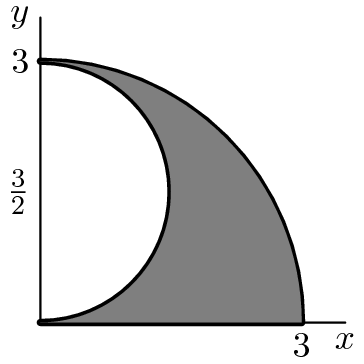
The shaded region below is called a shark's fin falcata, a figure studied by Leonardo da Vinci. It is bounded by the portion of the circle of radius and center that lies in the first quadrant, the portion of the circle with radius and center that lies in the first quadrant, and the line segment from to . What is the area of the shark's fin falcata?
Show solution without answering
Key insight
The shaded fin is a quarter of the big circle with half of the small circle cut out: 9pi/4 - 9pi/8 = 9pi/8.
Solution
The fin is what is left of a quarter circle after a smaller round piece is cut out of it. So find the two areas and subtract.
1. The big piece. The circle of radius centered at , cut to the first quadrant, is a quarter of a circle. Its area is
2. The piece cut out. The small circle has center and radius . Its lowest point is and its highest point is , so it sits on the -axis. The -axis cuts it exactly in half, and the right half is the part inside the first quadrant. Its area is
3. Subtract.
The answer is .
Why this works
Shapes bounded by circle arcs are usually "a bigger round piece minus a smaller round piece". For each arc, find its circle, then decide what fraction of that circle you need by looking at where the center is. Here the small circle's center is on the -axis, so the -axis splits it into two equal halves.
Concise solution
A shorter write-up, the way contest solutions are usually written. It may take a different route from the solution above.
The large circle, centered at the origin with radius , contributes the quarter disk in the first quadrant:
The small circle has center and radius , so it passes through and and its center sits on the -axis. Exactly half of it lies in the first quadrant (the right half), and that half disk is cut out of the quarter disk:
Falcata area:
The answer is .
Review in the AoPS books
- Introduction to Geometry, Chapter 11: Circles
- Introduction to Geometry, Chapter 4: Perimeter and Area (§4.2, §4.3)
- Introduction to Geometry, Chapter 12: Circles and Angles
- Introduction to Geometry, Chapter 13: Power of a Point
Similar problems
Problem © Mathematical Association of America (MAA), American Mathematics Competitions. Reproduced for non-commercial educational use. Solution and commentary are original to this site.