2002 AMC 10B Problem 5
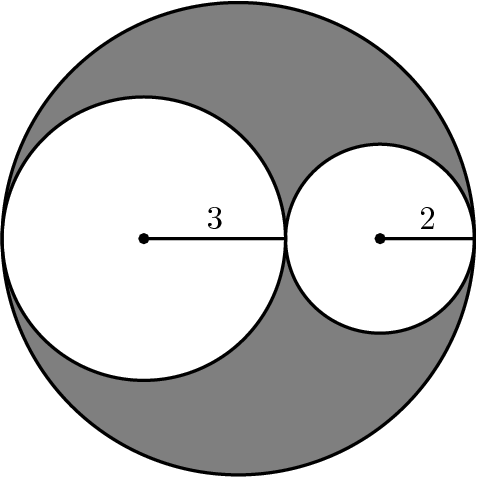
Circles of radius and are externally tangent and are circumscribed by a third circle, as shown in the figure. Find the area of the shaded region.
Show solution without answering
Key insight
The two small circles sit side by side across the big circle, so the big circle's diameter is 6 + 4 = 10 and its radius is 5.
Solution
To find the shaded area you need the big circle's size, so find its radius first.
1. In the figure the two small circles sit side by side, touching each other, and each one touches the big circle. A straight line through their two centers runs all the way across the big circle, through its center.
2. Along that line, the big circle's diameter is made of the two small diameters placed end to end:
3. The shaded region is the big circle with the two small circles cut out:
The answer is .
Why this works
When circles touch, the line joining their centers passes through the point where they touch. That lets you add up lengths along one straight line, which here gave the big diameter directly. Most shaded-area problems then come down to "whole shape minus the pieces cut out."
Concise solution
A shorter write-up, the way contest solutions are usually written. It may take a different route from the solution above.
Because the small circles are tangent to each other and each is tangent to the big circle, the line through their centers passes through both points where they touch the big circle and through the big circle's center. That line cuts across the big circle along a diameter made of the two small diameters laid end to end:
The shaded region is the big disk with the two small disks removed:
The answer is .
Review in the AoPS books
- Introduction to Geometry, Chapter 11: Circles
- Introduction to Geometry, Chapter 4: Perimeter and Area (§4.2, §4.3)
- Introduction to Geometry, Chapter 12: Circles and Angles
- Introduction to Geometry, Chapter 13: Power of a Point
Similar problems
Problem © Mathematical Association of America (MAA), American Mathematics Competitions. Reproduced for non-commercial educational use. Solution and commentary are original to this site.