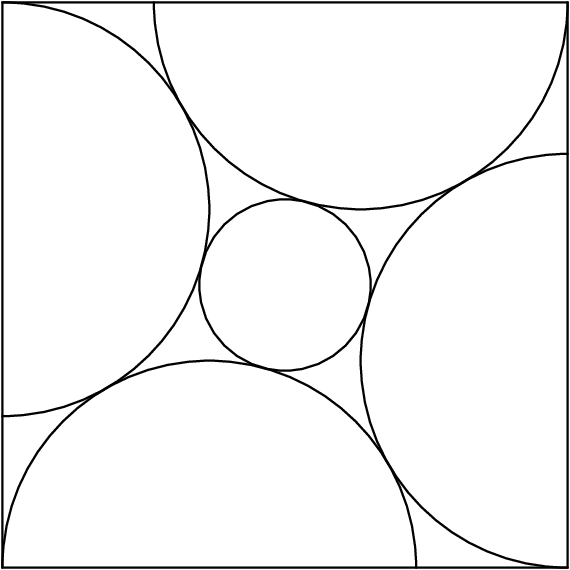
Four congruent semicircles are inscribed in a square of side length so that their diameters are on the sides of the square, one endpoint of each diameter is at a vertex of the square, and adjacent semicircles are tangent to each other. A small circle centered at the center of the square is tangent to each of the four semicircles, as shown below. The diameter of the small circle can be written as , where , , , and are integers. What is ?
- A)
- B)
- C)
- D)
- E)
Answer
A
Key insight
The four semicircle centres form a square of side 2r about the centre, so the centre lies r*sqrt(2) from each and the small radius is (sqrt(2)-1)r.
Solution
Put the square at and let be the common radius of the semicircles. Reading the figure, the four diameters follow each other round the square: one runs from to , the next from to , and so on. Their centres are
Finding . Adjacent semicircles are tangent and neither contains the other, so :
Finding the small radius. A rotation about the centre of the square carries the whole picture to itself and sends . So is a square centred at , and its side is the tangency distance . A square of side has circumradius , so
The small circle, of radius , sits between the four arcs and touches each from outside, so and
Therefore the diameter is
so , , , (or the two factors swapped), and
The answer is .
Why this works
Two tangency conditions are two distance equations, and both become trivial once the rotational symmetry is used: the centres of four congruent, cyclically tangent circles in a symmetric configuration always form a square, and the distance from the centre of symmetry to any of them is then immediate. That step replaces a messy surd computation by the relation , and the factored form drops out without any expansion — which is exactly the form the problem asks for. Note also that the answer only asks for integers, so negative and are allowed and should be expected when a length is a difference of surds.
Alternative approach
If the square of centres is not spotted, compute directly and simplify using the quadratic instead of substituting the surd. Since gives ,
Denesting, , so and
the same result.
The trap
Losing a minus sign when writing the diameter, giving (sqrt 2 - 1)(sqrt 3 + 1) and the sum 5 in (B).
Common mistakes
- Losing a minus sign when writing the diameter, giving and the sum in (B).
- Reporting the radius rather than the diameter, which cannot be put in the required form at all.
- Placing the semicircles centred at the midpoints of the sides, which ignores the condition that one endpoint of each diameter is a vertex and makes the tangency condition impossible.
Techniques
Place the figure on coordinates and compute · Exploit symmetry to reduce work or pair up objects