2014 AMC 10B Problem 22
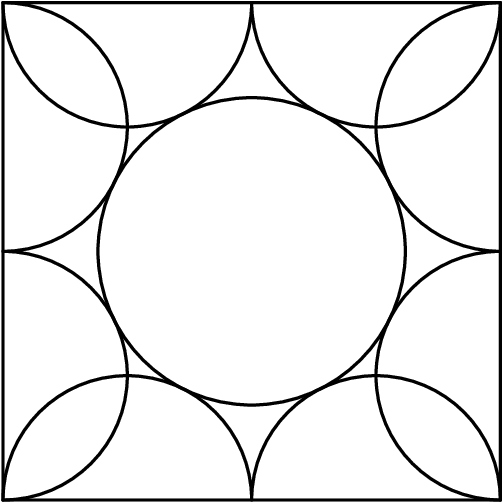
Eight semicircles line the inside of a square with side length 2 as shown. What is the radius of the circle tangent to all of these semicircles?
Show solution without answering
Key insight
The middle circle sits at the square's center. Its radius plus 1/2 equals the distance from the center to a semicircle's center, which is half of root 5.
Solution
1. Size of the semicircles. Each side of length holds two semicircles side by side, so each has diameter and radius .
2. Coordinates. Put the center of the square at , so its corners are . On the top side, the two semicircles are centered at the middles of the two halves: and . The other sides are the same picture turned.
3. Where is the middle circle? The picture looks the same after a quarter turn, so the circle touching all eight semicircles must be centered at . Call its radius .
4. Distance between centers. Use the semicircle centered at :
5. Touching circles. When two circles touch from the outside, the distance between their centers is the sum of the radii. (The touching point lies on the line joining the centers. That line points from down into the square, so it does meet the curved part of the semicircle.) So
6. Sense check: , so , a reasonable size for a circle inside a square of side .
The answer is .
Why this works
Two circles that touch are really a fact about their centers: the distance between centers equals the sum of the radii (touching from outside) or the difference (one inside the other). Symmetry tells you where the unknown center is, coordinates give the distance, and one equation finishes the job. With any group of touching circles, join the centers first.
Concise solution
A shorter write-up, the way contest solutions are usually written. It may take a different route from the solution above.
Put the square's center at the origin, so its vertices are . Each side of length carries two semicircles, so each semicircle has diameter and radius , with its center at the midpoint of a half-side. On the top side the two centers are ; the other six are the rotations of these.
By the square's symmetry the circle tangent to all eight semicircles is centered at the origin. Its radius is determined by tangency to any one semicircle, say the one centered at . The distance from the origin to that center is
The small circle and the semicircle are externally tangent, and the tangency point lies on the semicircle's arc (the segment from the semicircle's center toward the origin points into the square). So the distance between centers equals the sum of the radii:
The answer is .
Review in the AoPS books
- Introduction to Geometry, Chapter 11: Circles
- Introduction to Geometry, Chapter 16: The More Things Change. . . (§16.1, §16.2, §16.3, §16.4)
- Introduction to Geometry, Chapter 17: Analytic Geometry (§17.4, §17.6)
- Introduction to Algebra, Chapter 22: Special Manipulations (§22.3)
Similar problems
Problem © Mathematical Association of America (MAA), American Mathematics Competitions. Reproduced for non-commercial educational use. Solution and commentary are original to this site.