2020 AMC 10B Problem 14
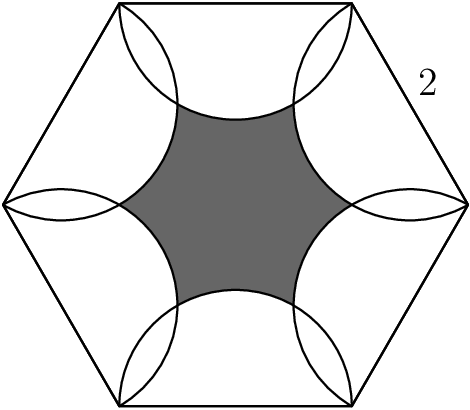
As shown in the figure below, six semicircles lie in the interior of a regular hexagon with side length 2 so that the diameters of the semicircles coincide with the sides of the hexagon. What is the area of the shaded region — inside the hexagon but outside all of the semicircles?
Show solution without answering
Key insight
Neighboring semicircles cross halfway between the center and each corner. The shaded part is six small triangles of side 1, each missing a curved bite.
Solution
Call the center of the hexagon . The hexagon has side , and each semicircle has radius and is centered at the midpoint of a side.
1. Split the hexagon. Draw lines from to all six corners. This cuts the hexagon into equilateral triangles of side . The picture is the same in each one, so study one of them: triangle , where is a side of the hexagon with midpoint .
2. Mark midpoints. Let be the midpoint of and the midpoint of . Joining , and cuts the big triangle into small equilateral triangles of side : triangle at the top, and three small triangles that each have as a corner.
3. Where the semicircle on reaches. Its center is and its radius is . The points , , , are all exactly from , since they are corners of small triangles of side with a corner at . So the three small triangles touching are completely covered, and the curved edge of the semicircle passes through and .
4. The top small triangle. Between and the arc bulges past the straight segment into triangle . That bulge is a circular "bite". The semicircles on the neighboring sides come in no further than line or between the corner and or , so they add nothing new here. So the shaded part of this big triangle is triangle with the bite removed.
5. Area of the bite. Triangle is equilateral with side , so the arc from to is a arc of a circle of radius . The bite is a slice of the circle minus triangle :
6. Shaded part of one big triangle.
7. All six.
The answer is .
Why this works
Before you subtract shapes from a region, check whether those shapes overlap. Here neighboring semicircles overlap near each corner, so "hexagon minus six half-circles" removes some area twice. Cutting the hexagon into equal pieces and marking midpoints shows exactly where each arc runs. The shaded region is then just small triangles minus circular bites, and each bite is a slice of a circle minus a triangle.
Alternative approach
Subtract first, then add back the overlaps. Hexagon area: . Six half-circles of radius : . Neighboring semicircles overlap in a lens shape between the shared corner and the crossing point near the center (the point or above). Each lens is two circular bites like the one in step 5, so its area is . That area was removed twice, so add it back once for each of the lenses:
Concise solution
A shorter write-up, the way contest solutions are usually written. It may take a different route from the solution above.
Let be the center. Each semicircle has radius and is centered at the midpoint of a side, with (the apothem).
Where do two adjacent semicircles meet? Their centers and the shared vertex satisfy and (triangle is equilateral). The second intersection point is the mirror image of across line . Since is at distance from that line and , the reflection puts at distance from .
So the six meeting points lie on a circle of radius around , spaced apart: they form a regular hexagon of side , and the shaded region is that inner hexagon with six circular arcs bulging inward.
Consider one side of the inner hexagon and the semicircle center on its far side. , so the arc subtends at , and the bite it takes out of the inner hexagon is a circular segment of area
Shaded area inner hexagon six segments:
The answer is .
Review in the AoPS books
- Introduction to Geometry, Chapter 11: Circles
- Introduction to Geometry, Chapter 8: Quadrilaterals
- Introduction to Geometry, Chapter 4: Perimeter and Area (§4.2, §4.3)
- Introduction to Geometry, Chapter 19: Problem Solving Strategies in Geometry (§19.1)
Similar problems
Problem © Mathematical Association of America (MAA), American Mathematics Competitions. Reproduced for non-commercial educational use. Solution and commentary are original to this site.