2012 AMC 10A Problem 18
The closed curve in the figure is made up of congruent circular arcs each of length , where each of the centers of the corresponding circles is among the vertices of a regular hexagon of side . What is the area enclosed by the curve?
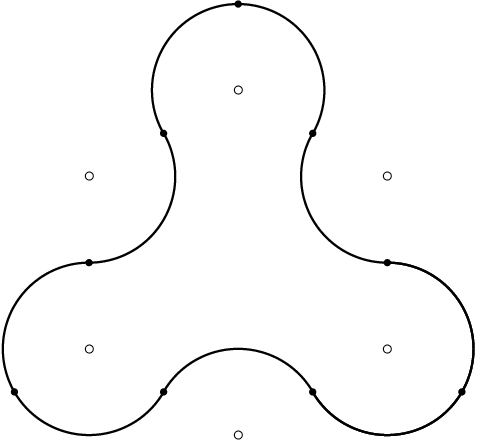
Show solution without answering
Key insight
Each arc has radius 1 and turns 120 degrees. Take the hexagon, add three outside bumps of 240 degrees, and remove three inside dents of 120 degrees.
Solution
Start from the hexagon and adjust: add the parts of the curve that bulge out, and take away the parts that dent in.
1. Radius of each arc. Each arc is centered at a corner of the hexagon and passes through the middles of the two sides at that corner. The sides have length , so the radius is .
2. Angle of each arc. A full circle of radius has length . An arc of length is one third of that, so it turns through .
3. Where the arcs go. Each inside angle of a regular hexagon is .
- At three corners (top, lower left, lower right in the figure), the curve goes around the outside of the corner, from one side's middle to the other. That sweeps , which is two arcs.
- At the other three corners, the curve dents inward with one arc, exactly filling the hexagon's corner angle.
- Count: arcs, as the problem says.
4. Hexagon. A regular hexagon of side is six equilateral triangles of side . Each has area , so the hexagon has area .
5. Bulges. Each is a slice of a circle of radius , lying outside the hexagon: . Three of them add .
6. Dents. Each removes a slice of radius from inside the hexagon: . Three of them take away .
7. Total: .
The answer is .
Why this works
A curve made of arcs centered at a polygon's corners is easiest to handle by starting with the polygon's area and then adding or removing circle slices. The polygon's angles tell you how big each slice is. Always turn "arc length" into "radius and angle" before working with areas.
Concise solution
A shorter write-up, the way contest solutions are usually written. It may take a different route from the solution above.
Read off the arcs first. Each arc is centered at a hexagon vertex and passes through the midpoints of the two sides at that vertex, so its radius is half the side, . An arc of length with radius subtends radians, i.e. .
At three alternate vertices the curve bulges outward: the two side-midpoints are joined by an arc going around the outside of the vertex. Since the hexagon's interior angle is , the outside sweep is , which is two of the nine arcs. At the other three vertices the curve dips inward through a single arc, exactly filling the interior angle. That accounts for arcs.
Now compute the area as hexagon plus bulges minus dents:
- Hexagon of side : .
- Each outward bulge is a sector of radius , lying entirely outside the hexagon: . Three of them add .
- Each inward dent removes a sector of radius : . Three of them remove .
Total: .
The answer is .
Review in the AoPS books
- Introduction to Geometry, Chapter 11: Circles
- Introduction to Geometry, Chapter 8: Quadrilaterals
- Introduction to Geometry, Chapter 2: Angles
- Introduction to Geometry, Chapter 4: Perimeter and Area (§4.2, §4.3)
Similar problems
Problem © Mathematical Association of America (MAA), American Mathematics Competitions. Reproduced for non-commercial educational use. Solution and commentary are original to this site.