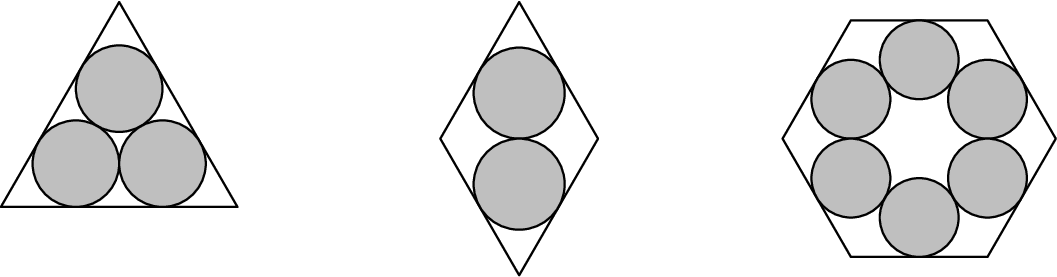
The figure below shows an equilateral triangle, a rhombus with a angle, and a regular hexagon, each of them containing some mutually tangent congruent disks. Let and respectively, denote the ratio in each case of the total area of the disks to the area of the enclosing polygon. Which of the following is true?
- A)
- B)
- C)
- D)
- E)
Answer
C
Key insight
The hexagon cuts into six equilateral triangles and the 60-degree rhombus into two, and in each figure the disks are exactly the incircles of those triangles, so H = R.
Solution
Each ratio is unchanged by scaling, so the three figures can be handled independently.
The hexagon and the rhombus are the same problem. Cut the regular hexagon into six equilateral triangles by the three long diagonals. The incircle of an equilateral triangle touches each side at its midpoint, so two incircles of neighbouring triangles touch the shared radius at the same point, namely its midpoint: they are tangent to each other. Each also touches one side of the hexagon. That is precisely the configuration drawn, so the six disks are the six incircles.
A rhombus with a angle is two equilateral triangles glued along the short diagonal, and the same argument applies: the two incircles each touch that diagonal at its midpoint, so they are tangent to each other, and each touches the two sides of its own triangle. So the two disks are those two incircles.
Hence and are both equal to the ratio of an incircle to its equilateral triangle. For side the inradius is and the area is , so
The triangle. Let the three disks have radius . Their centres form an equilateral triangle of side , concentric with the big triangle, and each centre lies on a bisector of a vertex angle at distance from that vertex. The centre of the big triangle is at distance from each disk centre (the circumradius of the centre triangle), so the big triangle has circumradius and therefore side
Its area is , while the disks total . So
Compare. is equivalent to , i.e. , i.e. , i.e. , which is true. So .
The answer is .
Why this works
Packing ratios are scale-free, so the only real content is identifying each configuration. Dissecting a figure into the equilateral triangles it is built from is the standard move for shapes, and here it does more than simplify arithmetic: it shows the hexagon and the rhombus carry literally the same local picture, so exactly rather than by coincidence of decimals. The triangle is genuinely different because its three disks sit against two sides each and leave a curved hole in the middle, and it turns out to waste less area. The same dissection settles the analogous question for any figure tiled by equilateral triangles with an inscribed disk in each: the ratio is always .
Alternative approach
Set in all three pictures and compute raw areas. Hexagon: each disk is inscribed in an equilateral triangle of side , so the hexagon has area against . Rhombus: two such triangles, against . Both give . Triangle: side , area against , giving .
The trap
Assuming congruent mutually tangent disks fill all three polygons equally well and answering T = H = R at choice (A).
Common mistakes
- Assuming congruent mutually tangent disks fill all three polygons equally well and answering T = H = R at choice (A).
- Guessing that more disks means a better fit and ordering ; the hexagon's six small disks are no more efficient than the rhombus's two.
- Taking the disks in the hexagon to be centred at the midpoints of the radii or at the vertices of a smaller hexagon, rather than at the centroids of the six triangles, which breaks the tangency conditions.
Techniques
Set up the equation/formula and compute; no special trick needed · Cut the figure into known shapes (triangles, rectangles, sectors) · Exploit symmetry to reduce work or pair up objects