2022 AMC 10A Problem 10
Daniel finds a rectangular index card and measures its diagonal to be centimeters. Daniel then cuts out equal squares of side cm at two opposite corners of the index card and measures the distance between the two closest vertices of these squares to be centimeters, as shown below. What is the area of the original index card? 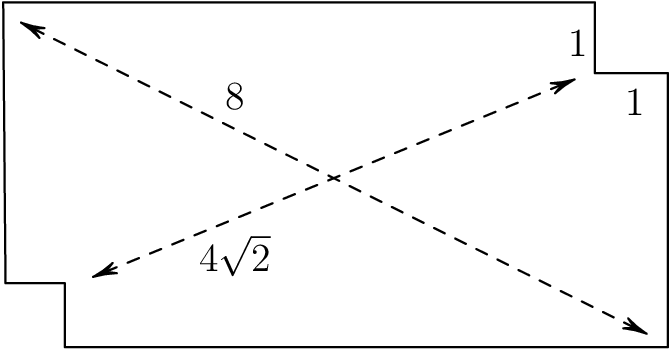
Show solution without answering
Key insight
Call the sides a and b. The two measurements give a squared plus b squared = 64 and a + b = 10; the area ab follows directly.
Solution
1. Name the sides. Let the card be by . The diagonal is , so by the Pythagorean theorem
2. Place the card on a grid with corners , , , . Cut the squares from the bottom-left and top-right corners. The two closest corners of the cut squares are their inner corners, and .
3. Distance between them. Going from one to the other you move across and up. By the Pythagorean theorem again,
4. Find . Multiply out: . Replace by :
5. Find the area . We know and , and the square of a sum connects them:
So and .
The answer is .
Why this works
The question asks for the product , not the two sides. Knowing and is enough, because links them. Whenever the target treats and the same way, look for a shortcut like this before solving for each one.
Alternative approach
If you want the actual sides: two numbers with sum and product are and . Check: , and .
Concise solution
A shorter write-up, the way contest solutions are usually written. It may take a different route from the solution above.
Let the card have side lengths and . The diagonal gives
Place the card with corners , , , and cut the unit squares at and . The two vertices closest to each other are the inner corners and , so
Expanding: , and using gives , so .
The area is , and
so .
The answer is .
Review in the AoPS books
- Introduction to Geometry, Chapter 8: Quadrilaterals
- Introduction to Geometry, Chapter 4: Perimeter and Area (§4.2)
- Introduction to Algebra, Chapter 11: Special Factorizations (§11.2, §11.3, §11.5)
- Introduction to Geometry, Chapter 17: Analytic Geometry (§17.4, §17.6)
Similar problems
Problem © Mathematical Association of America (MAA), American Mathematics Competitions. Reproduced for non-commercial educational use. Solution and commentary are original to this site.