Daniel finds a rectangular index card and measures its diagonal to be centimeters. Daniel then cuts out equal squares of side cm at two opposite corners of the index card and measures the distance between the two closest vertices of these squares to be centimeters, as shown below. What is the area of the original index card? 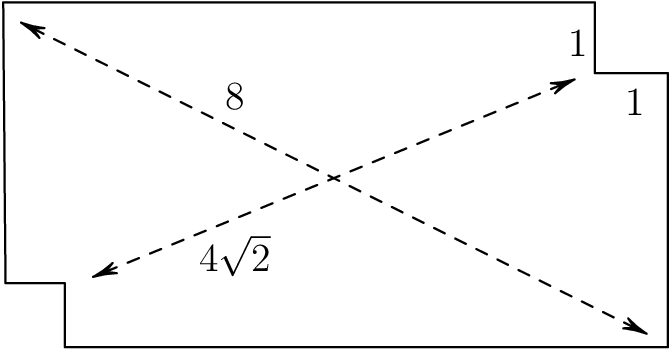
- A)
- B)
- C)
- D)
- E)
Answer
E
Key insight
With sides a, b: a^2 + b^2 = 64 and (a-2)^2 + (b-2)^2 = 32; subtracting gives a + b = 10, then 2ab = 10^2 - 64 = 36.
Solution
Let the card have side lengths and . The diagonal gives
Place the card with corners , , , and cut the unit squares at and . The two vertices closest to each other are the inner corners and , so
Expanding: , and using gives , so .
The area is , and
so .
The answer is .
Why this works
Two distance measurements produce two equations in and , but the question asks for , a symmetric expression. Symmetric targets are reached through and without ever finding and themselves; the identity is the bridge.
Alternative approach
Notice the segment between the inner corners is the diagonal of an rectangle, giving the same second equation. If you do solve, and give , and confirms.
The trap
Trying to solve for a and b individually (they are 5 plus or minus sqrt 7) instead of going straight for ab through (a+b)^2 - (a^2+b^2).
Common mistakes
- Trying to solve for a and b individually (they are 5 plus or minus sqrt 7) instead of going straight for ab through (a+b)^2 - (a^2+b^2).
- Using for the inner-corner distance, forgetting that a unit square is removed at both ends of the segment.
Techniques
Apply an identity: SFFT, sum of squares, difference of cubes, Vieta · Place the figure on coordinates and compute