2022 AMC 10A Problem 9
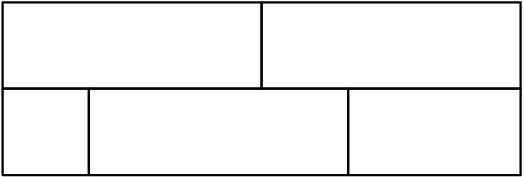
A rectangle is partitioned into regions as shown. Each region is to be painted a solid color - red, orange, yellow, blue, or green - so that regions that touch are painted different colors, and colors can be used more than once. How many different colorings are possible?
Show solution without answering
Key insight
The wide bottom-middle region touches all four others. Paint it first, then go around the other four in order: 4 choices for the first, then 3 for each.
Solution
1. Name the regions. Bottom row, left to right: a small piece , a wide middle piece , and a right piece . Top row: a left piece and a right piece .
2. Which regions touch? Reading the picture:
- touches all four others: , , and .
- touches ; touches ; touches .
- does not touch or , and does not touch .
3. Paint the busiest region first. touches everything, so it limits the most. It gets any of the colors.
4. Go around the other four in the order . Each one touches and the region painted just before it, and those two already have different colors:
- : any color except 's. choices.
- : not 's color and not 's. choices.
- : not 's and not 's. choices.
- : not 's and not 's. choices.
5. Multiply. .
The answer is .
Why this works
When counting colorings, choose an order in which each new region has a known number of already-painted neighbors, all with different colors. Starting with the region that touches everything does this: every later region sees exactly two different colors (or one, for the first), so each count is a fixed number and you simply multiply.
Concise solution
A shorter write-up, the way contest solutions are usually written. It may take a different route from the solution above.
Name the regions: the bottom row has a small left piece , a wide middle piece , and a right piece ; the top row has a left piece and a right piece . Reading the figure, touches all four others; touches ; touches ; touches . The pairs and and do not touch.
Color first: choices. Then color the others in the order , so that each new region touches exactly two already-colored regions, and the previous one, which always have different colors:
- : any color but 's, choices.
- : not 's or 's color, choices.
- : not 's or 's color, choices.
- : not 's or 's color, choices.
Total: .
The answer is .
Review in the AoPS books
- Introduction to Counting & Probability, Chapter 2: Basic Counting Techniques (§2.5)
- Introduction to Counting & Probability, Chapter 1: Counting Is Arithmetic
- Introduction to Counting & Probability, Chapter 3: Correcting for Overcounting (§3.2, §3.4)
- Introduction to Counting & Probability, Chapter 4: Committees and Combinations
Similar problems
Problem © Mathematical Association of America (MAA), American Mathematics Competitions. Reproduced for non-commercial educational use. Solution and commentary are original to this site.