2022 AMC 10B Problem 16
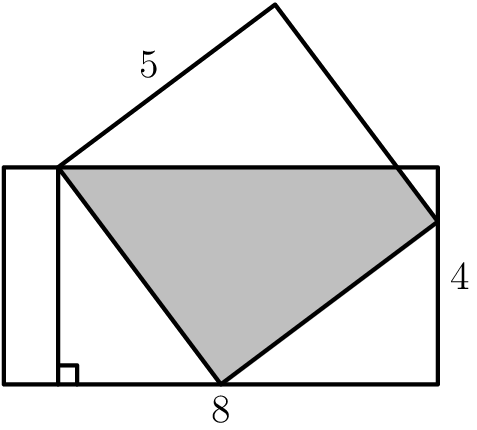
The diagram below shows a rectangle with side lengths and and a square with side length . Three vertices of the square lie on three different sides of the rectangle, as shown. What is the area of the region inside both the square and the rectangle?
Show solution without answering
Key insight
The square's side from the bottom edge to the top edge is 5 long and rises 4, so it is tilted like a 3-4-5 triangle. Subtract the corner sticking out.
Solution
The overlap is the whole square minus the small triangle that sticks out of the top of the rectangle. So first pin down exactly where the square sits.
1. Set up coordinates. Put the rectangle's bottom-left corner at and its top-right corner at . Call the square's corners (on the bottom side), (on the right side), (on the top side) and (the corner outside, above the rectangle).
2. The side . It is long and goes from the bottom side up to the top side, so it rises . By the Pythagorean theorem it moves sideways. From the figure it goes left, so is left and up from . (The figure draws this right triangle, with a vertical line from down to the bottom side.)
3. The side . It is the side turned a quarter turn, so the and the swap: is right and up from .
4. Find the points. is on the right side, where , so is at . That gives
is left and up from , so .
5. The piece sticking out. Only the part above the line is outside the rectangle. It is a triangle with corners , , and the point where side crosses the top of the rectangle. It has a right angle at , because is a corner of the square, and the side is .
6. Its other leg, . The side goes from to : across and up. So triangle has the same shape as a -- triangle lying on its long side: its right angle is at , and the leg is to the leg as is to . So .
7. Area of the piece. .
8. Overlap. .
The answer is .
Why this works
A square of side that stretches across a rectangle of height has to be tilted like a -- triangle. Because neighbouring sides of a square are the same length and at right angles, knowing one side's "across and up" tells you the next side's too (the numbers swap). Once the square is placed, the overlap is simply the square minus the triangle poking out, and that triangle has the same shape.
Alternative approach
Check step 6 with coordinates. Side goes from to : left for every up. To rise from to it goes left, so . Then the triangle has a base along the top edge and a height of above it, so its area is , the same as before.
Concise solution
A shorter write-up, the way contest solutions are usually written. It may take a different route from the solution above.
Place the rectangle with corners and . Call the square's vertices (on the bottom side), (on the right side), (on the top side) and (outside), with and the two sides meeting at .
Going from to moves with ; since is rotated , going from to moves . is on the top side, units above , so and then . Thus is right and up from ; since is on the right side, , , and .
The only part of the square outside the rectangle is the piece above the top side : triangle , where is where side crosses . This triangle has a right angle at (a corner of the square) and . Side has slope , so has tangent and
Its area is .
The overlap is therefore .
The answer is .
Review in the AoPS books
- Introduction to Geometry, Chapter 8: Quadrilaterals
- Introduction to Geometry, Chapter 3: Congruent Triangles
- Introduction to Geometry, Chapter 4: Perimeter and Area (§4.2)
- Introduction to Geometry, Chapter 17: Analytic Geometry (§17.4, §17.6)
Similar problems
Problem © Mathematical Association of America (MAA), American Mathematics Competitions. Reproduced for non-commercial educational use. Solution and commentary are original to this site.