2021 AMC 10B Problem 20
The figure is constructed from line segments, each of which has length . The area of pentagon can be written as , where and are positive integers. What is 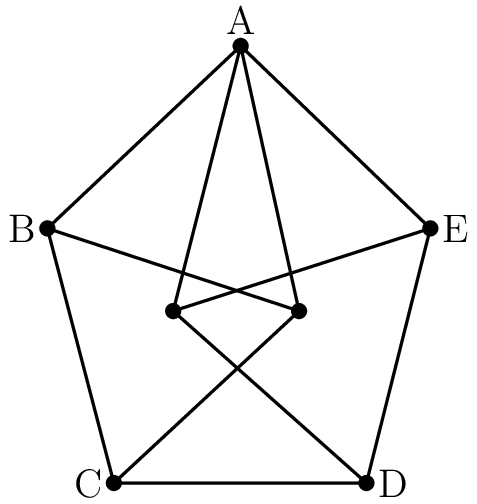
Show solution without answering
Key insight
Triangles ABF and BCF are equilateral, so the diagonal AC is 2√3, and the same holds for AD. Cut the pentagon into triangles ABC, ACD, ADE.
Solution
Step 1: find the equilateral triangles.
- Name the two inside points: is joined to , and , and is joined to , and . The segments are the sides of the pentagon and these inside segments, all of length .
- Triangle has sides , , , all equal to , so it is equilateral. Triangle has sides , , , all , so it is equilateral too.
- The same happens on the other side: triangles and are equilateral.
Step 2: find the diagonal .
- Put the two equilateral triangles and together along . They form a diamond shape with all sides .
- Its long diagonal crosses the shared side at a right angle and is made of the two heights of the equilateral triangles. The height of an equilateral triangle with side is . So .
- By the same reasoning, .
Step 3: cut the pentagon into three triangles from .
- Triangle . The diagonal cuts the diamond exactly in half. The diamond is two equilateral triangles, each of area , so the diamond has area and triangle has area .
- Triangle . The same way, its area is .
- Triangle . Its sides are and . The height from meets at its midpoint, so by the Pythagorean theorem the height is . The area is .
Step 4: add up.
- The total area is .
- The answer must look like , so write . The area is , and .
The answer is .
Why this works
When many segments have the same length, look for equilateral triangles first. They give you angles and lengths, such as the diagonal . With the diagonals from known, the pentagon splits into three triangles you can handle with basic tools. The form is a hint to move the inside the square root.
Concise solution
A shorter write-up, the way contest solutions are usually written. It may take a different route from the solution above.
Let be the interior point joined to , , and the interior point joined to , , . The eleven segments are the five sides plus , all of length .
Triangles and have all sides equal to , so both are equilateral. Therefore , and is a rhombus with side and a angle at ; its long diagonal is . By the same reasoning on the right, and .
Now split the pentagon by the diagonals from :
- , and likewise .
- Triangle is isosceles with and base . Its altitude from is , so .
Total area: , so .
The answer is .
Review in the AoPS books
- Introduction to Geometry, Chapter 8: Quadrilaterals
- Introduction to Geometry, Chapter 4: Perimeter and Area (§4.2)
- Introduction to Geometry, Chapter 2: Angles
- Introduction to Geometry, Chapter 19: Problem Solving Strategies in Geometry (§19.1)
Similar problems
Problem © Mathematical Association of America (MAA), American Mathematics Competitions. Reproduced for non-commercial educational use. Solution and commentary are original to this site.