2021 AMC 10B Problem 21
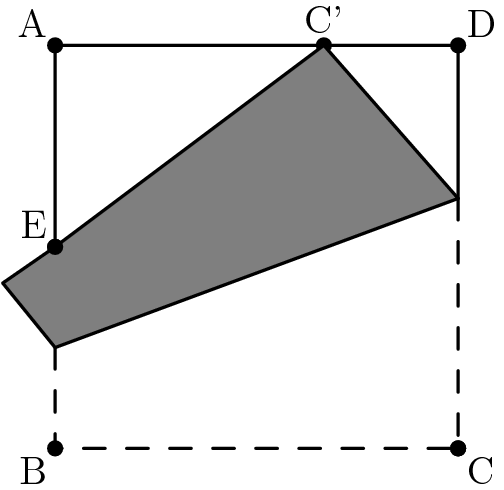
A square piece of paper has side length and vertices and in that order. As shown in the figure, the paper is folded so that vertex meets edge at point , and edge at point . Suppose that . What is the perimeter of triangle
Show solution without answering
Key insight
Folding keeps lengths, so the small right triangle at D has sides 1/3, 4/9, 5/9. Triangle AEC' has the same shape, 3/2 times as big, so its perimeter is 2.
Solution
Folding is like reflecting in a mirror: any piece of the paper keeps its lengths and angles after the fold.
Step 1: the small triangle at .
1. Let be where the fold line meets side . The piece folds over onto , so .
2. Let . Side has length , so , and therefore too.
3. Triangle has a right angle at (a corner of the square), with legs and , and longest side . By the Pythagorean theorem,
4. The cancels: , so and . Then .
5. So triangle has sides , , (a -- triangle, shrunk). Its perimeter is .
Step 2: the two triangles have the same shape.
- The corner of the square was a right angle, so after folding the angle is also a right angle.
- At the point , three angles sit side by side along the straight edge : angle , the right angle , and angle . They add to , so angle and angle add to .
- In the right triangle , the two sharp angles also add to : angle plus angle is .
- Comparing steps 7 and 8, angle equals angle . Both triangles and also have a right angle (at and at ). So they have the same three angles, which means the same shape.
Step 3: scale up.
- Match the sides. In triangle , the side sits between the right angle and the angle at . In triangle , the matching side sits between the right angle and the angle at .
- and . So triangle is times as big.
- Its perimeter is .
The answer is .
Why this works
A fold keeps lengths () and keeps the right angle at the folded corner. A right angle resting on a straight edge always creates two same-shape right triangles on either side of it. One triangle can be solved with the Pythagorean theorem, and the other follows by scaling. (In fact the answer is always , half the square's perimeter, wherever lands on .)
Alternative approach
Use coordinates: , , , , so .
- The fold line is the perpendicular bisector of . The midpoint of is , and has slope , so the fold line has slope .
- Reflecting over this line gives . The folded edge runs from through , with slope .
- That edge crosses the left side at .
- So , , and . The perimeter is .
Concise solution
A shorter write-up, the way contest solutions are usually written. It may take a different route from the solution above.
Let be the point where the crease meets side . Folding is a reflection across the crease, so and the right angle at is carried to : .
Triangle . Let , so . Right triangle gives
so . Its perimeter is (equivalently , since ).
Similarity. At the angles , , and lie along line , so . In right triangle , as well, hence . With right angles at and , triangles and are similar, and the ratio is
Perimeters scale by the same ratio: perimeter of is .
The answer is .
Review in the AoPS books
- Introduction to Geometry, Chapter 16: The More Things Change. . . (§16.1, §16.2, §16.3, §16.4)
- Introduction to Geometry, Chapter 3: Congruent Triangles
- Introduction to Geometry, Chapter 4: Perimeter and Area (§4.2)
- Introduction to Algebra, Chapter 22: Special Manipulations (§22.3)
Similar problems
Problem © Mathematical Association of America (MAA), American Mathematics Competitions. Reproduced for non-commercial educational use. Solution and commentary are original to this site.