2020 AMC 10B Problem 21
In square , points and lie on and , respectively, so that Points and lie on and , respectively, and points and lie on so that and . See the figure below. Triangle , quadrilateral , quadrilateral , and pentagon each has area What is ? 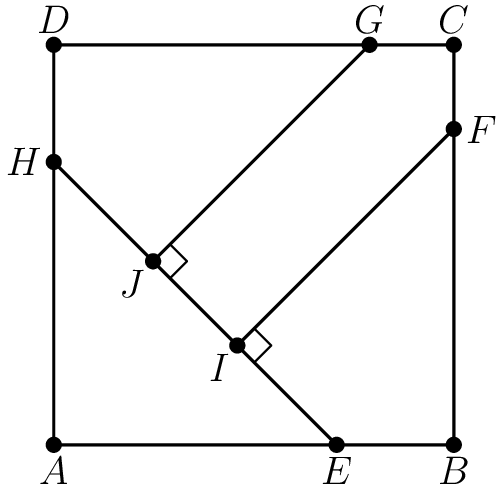
Show solution without answering
Key insight
Extend CB and CD to meet line EH. The pentagon is a big half-square triangle minus two small half-square corners, each of area FI squared over 2.
Solution
1. Side of the square. The four regions fill the square and each has area , so the square has area and side .
2. Triangle . It has a right angle at and , so it is a -- triangle (half of a square). Area gives . Its long side is .
3. Use the diagonal . The figure is symmetric about the diagonal , and crosses it at a right angle. The distance from to is half of , which is (in a half-square triangle the height to the long side is half that side). The diagonal is . So the distance from to line is
4. Make a big triangle. Extend sides and past and until they hit line at points and . Triangle has a right angle at and is symmetric about , so it is also a half-square triangle. Its height from is , so its long side is and its area is
5. The pentagon is this triangle with two corners cut off. Corner triangle has a right angle at (since ) and a angle at , because line makes a angle with side . So it is a half-square triangle too, with . Call . Its area is .
6. By the symmetry about , corner triangle is the same size. (Quadrilaterals and have equal area, which forces to be the mirror image of .)
7. Set up the equation.
8. Solve.
The answer is .
Why this works
Everything is symmetric about the diagonal , and is perpendicular to it, so every slanted line in the picture is at to the sides of the square. That makes every triangle in sight a half-square triangle, whose area depends on just one length. Instead of finding and , grow the pentagon into a simple triangle and subtract the two corners. The unknown then shows up on its own.
Alternative approach
Coordinates also work, just more slowly. Put and , so line is . Put and, by symmetry, . Split the pentagon into rectangle plus triangle , set the total area to , and solve for . The distance from to line is , and squaring it again gives .
Concise solution
A shorter write-up, the way contest solutions are usually written. It may take a different route from the solution above.
The four regions tile the square, so its area is and its side is . Triangle is right isosceles with area , so and ; its altitude from to has length . Since , the distance from to line is
Extend and until they meet line at and . Triangle has a right angle at and is symmetric about , so it is right isosceles with altitude from to ; its hypotenuse is and its area is .
The pentagon is this triangle with two corners cut off: triangle (right angle at , at ) and triangle . Let . Then and the area of is ; the same holds for . Therefore
So
The answer is .
Review in the AoPS books
- Introduction to Geometry, Chapter 8: Quadrilaterals
- Introduction to Geometry, Chapter 4: Perimeter and Area (§4.2)
- Introduction to Geometry, Chapter 3: Congruent Triangles
- Introduction to Geometry, Chapter 19: Problem Solving Strategies in Geometry (§19.1)
Similar problems
Problem © Mathematical Association of America (MAA), American Mathematics Competitions. Reproduced for non-commercial educational use. Solution and commentary are original to this site.