The figure is constructed from line segments, each of which has length . The area of pentagon can be written as , where and are positive integers. What is 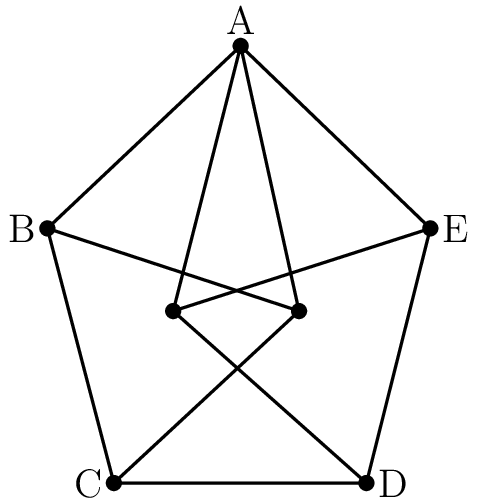
- A)
- B)
- C)
- D)
- E)
Answer
D
Key insight
Triangles ABF and BCF are equilateral, so ∠ABC = 120° and AC = 2√3; the pentagon is the fan ABC + ACD + ADE from A.
Solution
Let be the interior point joined to , , and the interior point joined to , , . The eleven segments are the five sides plus , all of length .
Triangles and have all sides equal to , so both are equilateral. Therefore , and is a rhombus with side and a angle at ; its long diagonal is . By the same reasoning on the right, and .
Now split the pentagon by the diagonals from :
- , and likewise .
- Triangle is isosceles with and base . Its altitude from is , so .
Total area: , so .
The answer is .
Why this works
Many equal segments means equilateral triangles hiding in the figure; find them first, because they hand you angles (, ) and lengths ( diagonals). Once the key diagonals and are known, the pentagon is a fan of three triangles from one vertex, each computable with basic tools. The final form tells you to absorb the coefficient: .
The trap
Assuming the pentagon is regular, or adding four equilateral triangles plus a 'middle region' without noticing that segments FC and GD cross.
Common mistakes
- Assuming the pentagon is regular, or adding four equilateral triangles plus a 'middle region' without noticing that segments FC and GD cross.
- Leaving the answer as and reading as or .
Techniques
Add construction lines/points (drop altitudes, extend segments, connect centers) · Cut the figure into known shapes (triangles, rectangles, sectors)