2016 AMC 10A Problem 11
Find the area of the shaded region. 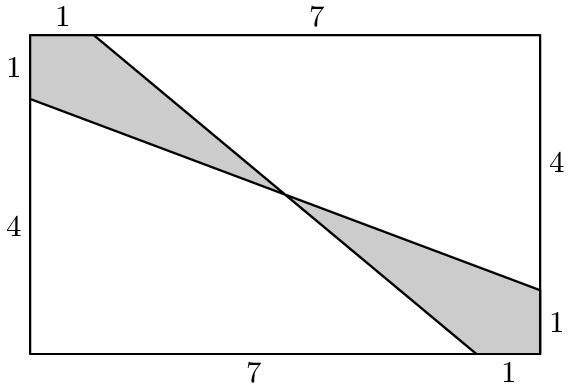
Show solution without answering
Key insight
Turning the picture half a turn about the rectangle's center leaves it unchanged, so the slanted lines cross at the center and the two shaded pieces are equal.
Solution
Put the rectangle on a grid with corners and . From the labels, one slanted segment runs from on the top edge to on the bottom edge, and the other runs from on the left edge to on the right edge. The shaded region is a bow-tie: a piece in the top-left corner and a piece in the bottom-right corner, touching where the two segments cross.
1. Find the crossing point. Spin the rectangle half a turn about its center . The point lands on and lands on , so each slanted segment lands on itself. A segment that is unchanged by a half turn about a point must pass through that point. So both segments go through the center, and they cross at .
2. The two pieces are equal. The same half turn carries the top-left shaded piece onto the bottom-right one. So we only need the top-left piece and then double it.
3. The top-left piece has corners , , and . Cut it along the line from the corner to into two triangles:
- Triangle : its base along the top edge has length , and is below that edge. Area .
- Triangle : its base along the left edge has length , and is to the right of that edge. Area .
So the top-left piece has area .
4. The shaded region is two such pieces: .
The answer is .
Why this works
The labels on top and bottom and on the sides are arranged the same way after a half turn, which tells you the whole figure has that symmetry. Symmetry finds the crossing point for free and cuts the work in half. Splitting an odd shape into triangles whose bases lie along the rectangle's edges makes every height easy to read.
Alternative approach
Use a parallelogram. The four endpoints , , , form a parallelogram (the short sides both go right and up), and the two slanted segments are its diagonals. Its area is the rectangle minus four corner triangles: . The diagonals cut a parallelogram into four triangles of equal area, and the bow-tie holds two of them, which is , plus the two small corner triangles of area each. Total: .
Concise solution
A shorter write-up, the way contest solutions are usually written. It may take a different route from the solution above.
Place the rectangle with corners and . Reading the labels, the shaded region is bounded by the segment from to , the segment from to , and the two short -unit pieces of the rectangle's boundary at the top-left and bottom-right corners.
Look at the quadrilateral . Its sides and are both the vector , so is a parallelogram, and the two slanted segments are exactly its diagonals. The diagonals of a parallelogram split it into four triangles of equal area, and the shaded region contains two opposite ones, i.e. half of , together with the two small right triangles at the corners and , each with legs and .
Area of : subtract the four unshaded corner triangles from the rectangle:
Shaded area .
The answer is .
Review in the AoPS books
- Introduction to Geometry, Chapter 8: Quadrilaterals
- Introduction to Geometry, Chapter 4: Perimeter and Area (§4.2, §4.3)
- Introduction to Algebra, Chapter 22: Special Manipulations (§22.3)
- Introduction to Geometry, Chapter 9: Polygons (§9.3)
Similar problems
Problem © Mathematical Association of America (MAA), American Mathematics Competitions. Reproduced for non-commercial educational use. Solution and commentary are original to this site.