Find the area of the shaded region. 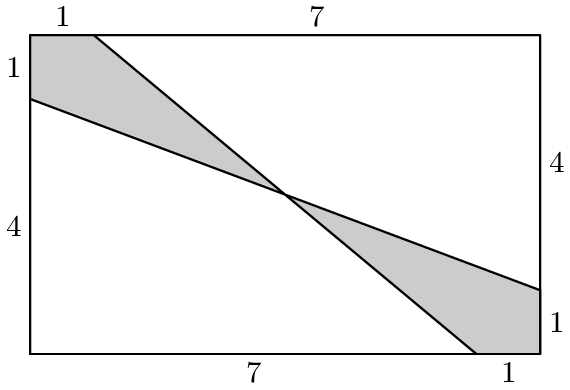
- A)
- B)
- C)
- D)
- E)
Answer
D
Key insight
The two slanted segments are the diagonals of a parallelogram, so the shaded bow-tie is half that parallelogram plus two tiny corner triangles.
Solution
Place the rectangle with corners and . Reading the labels, the shaded region is bounded by the segment from to , the segment from to , and the two short -unit pieces of the rectangle's boundary at the top-left and bottom-right corners.
Look at the quadrilateral . Its sides and are both the vector , so is a parallelogram, and the two slanted segments are exactly its diagonals. The diagonals of a parallelogram split it into four triangles of equal area, and the shaded region contains two opposite ones, i.e. half of , together with the two small right triangles at the corners and , each with legs and .
Area of : subtract the four unshaded corner triangles from the rectangle:
Shaded area .
The answer is .
Why this works
A region bounded by two crossing segments is a bow-tie, not a simple polygon, so decompose it rather than applying a formula blindly. Recognizing the two segments as diagonals of a parallelogram converts the awkward shape into "half a parallelogram," and the parallelogram itself is a rectangle minus four right triangles. Always check whether slanted segments in a figure are parallel or equal; that structure is usually the intended shortcut.
Alternative approach
Coordinates: the segments and meet at , the center of the rectangle. Shoelace on the quadrilateral gives ; the other half is congruent by the symmetry about the center, so the total is .
The trap
Treating the shaded figure as one simple hexagon and running shoelace around its six listed corners, which gives 0 because the boundary crosses itself.
Common mistakes
- Treating the shaded figure as one simple hexagon and running shoelace around its six listed corners, which gives 0 because the boundary crosses itself.
- Forgetting the two small corner triangles and answering , or including the whole parallelogram and getting .
Techniques
Cut the figure into known shapes (triangles, rectangles, sectors) · Exploit symmetry to reduce work or pair up objects