2006 AMC 10B Problem 15
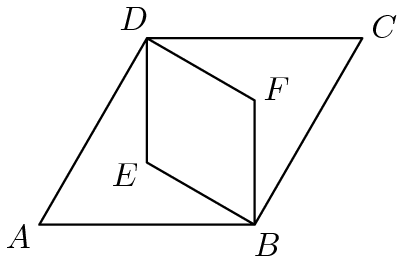
Rhombus is similar to rhombus . The area of rhombus is and . What is the area of rhombus ?
Show solution without answering
Key insight
BD is the short diagonal of the big rhombus but the long diagonal of the small one, so lengths shrink by the square root of 3 and area by 3.
Solution
1. The big rhombus. Let each side be . Since and the angle at is , triangle has two equal sides with a angle between them, so it is equilateral. The same is true of triangle . So the big rhombus is two equilateral triangles glued together along , and .
2. The other diagonal goes across both triangles through their heights. The height of an equilateral triangle with side is , so
So is the short diagonal and is the long one.
3. The small rhombus. It is similar to the big one, so it also has angles and . In the figure, and sit close to the segment , so the wide angles are at and and the narrow angles are at and . The diagonal joining the two narrow corners is the long one, so is the long diagonal of .
4. Compare matching lengths. Long diagonal to long diagonal:
5. Areas of similar shapes compare as the square of matching lengths: . So the small rhombus has area .
The answer is .
Why this works
A rhombus with a angle is two equilateral triangles, so its diagonals are always in the ratio , with no measuring needed. For similar shapes, the area ratio is the square of the length ratio, but only if you compare lengths that play the same role in both shapes. The main work is deciding which diagonal of the small rhombus matches which diagonal of the big one.
Alternative approach
Cut into equal pieces. Triangle has angles , , with the angle at , so is the center of equilateral triangle . Lines from the center to the three corners split into three equal triangles, so triangle is of triangle , which is half of , so . Triangle is also in the same way. The small rhombus has area .
Concise solution
A shorter write-up, the way contest solutions are usually written. It may take a different route from the solution above.
Let the side of be . Since and , triangle is equilateral, and so is triangle . Hence the short diagonal is , and the long diagonal is twice the altitude of an equilateral triangle: .
Now look at rhombus . Its angles are also and (it is similar to ). In the figure and sit close to segment , so the angles at and are the obtuse ones and the angles at and are . The diagonal joining the two acute vertices of a rhombus is the longer one, so is the long diagonal of .
Matching long diagonal to long diagonal, the similarity ratio is
so the areas are in ratio . The area of is .
The answer is .
Review in the AoPS books
- Introduction to Geometry, Chapter 8: Quadrilaterals
- Introduction to Geometry, Chapter 3: Congruent Triangles
- Introduction to Geometry, Chapter 2: Angles
- Introduction to Geometry, Chapter 4: Perimeter and Area (§4.2, §4.3)
Similar problems
Problem © Mathematical Association of America (MAA), American Mathematics Competitions. Reproduced for non-commercial educational use. Solution and commentary are original to this site.