2021 AMC Fall 10B Problem 18
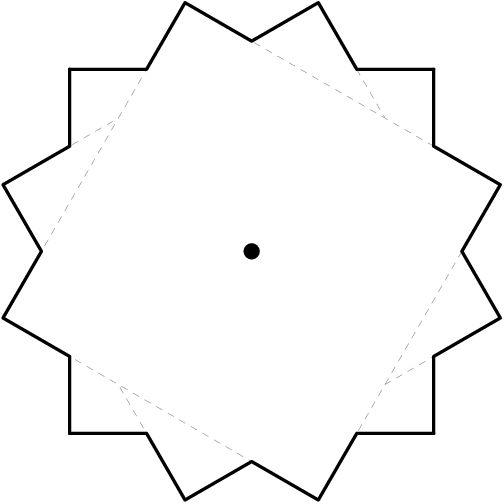
Three identical square sheets of paper each with side length are stacked on top of each other. The middle sheet is rotated clockwise about its center and the top sheet is rotated clockwise about its center, resulting in the -sided polygon shown in the figure below. The area of this polygon can be expressed in the form , where , , and are positive integers, and is not divisible by the square of any prime. What is
Show solution without answering
Key insight
The outline's 24 corners alternate: a square corner, then a crossing point halfway to the next one. So the shape splits into 24 identical thin triangles.
Solution
1. Set up. Put the common center at and let the bottom sheet have corners at . Its corner is at from the positive -axis. The other two sheets are the same square turned and , so all twelve corners are at the same distance from the center, spaced every : at
2. Where are the other 12 corners of the outline? Between two neighboring square corners, the outline dips inward to a point where two sheets' edges cross. The whole picture looks the same after a turn, and it is also symmetric across the line halfway between two neighboring square corners. So each crossing point sits exactly halfway, on the lines at
3. Find one crossing point. Take the corner at . Walking clockwise from along the bottom sheet's right edge , you reach the crossing point on the line. On the line, height distance across (a -- triangle). With distance across , the height is . So .
4. One thin triangle. Triangle has corners , , . Use as the base: it lies on the line and has length . The height is the distance from to that line, which is . Area:
5. All 24 triangles. Going around the center, the outline is made of copies of this triangle (corner to crossing point, crossing point to corner, and so on). Total area:
6. So , , , and .
The answer is .
Why this works
When identical shapes are stacked around a common center and turned by equal steps, the result repeats all the way around. Find the smallest slice that repeats, compute its area, and multiply. The key fact is that the outline's corners alternate between square corners and crossing points at equal angle steps, which tells you exactly which line each crossing point lies on.
Alternative approach
A quick size check helps catch slips. The shape contains one whole square, area , and it fits inside the circle through all the corners, which has radius and area . The answer lies between these, as it must.
Concise solution
A shorter write-up, the way contest solutions are usually written. It may take a different route from the solution above.
Put the common center at the origin with the bottom sheet axis-aligned, so its corners are at , at angles from the center. The other sheets' corners sit at the same distance, every : the twelve corners are at .
Rotating the whole picture by sends each sheet to another sheet, so the polygon has -fold rotational symmetry; reflecting in the line at angle swaps the and sheets and fixes the sheet, so that line is a mirror as well. Hence the vertices are the corners together with intersection points, one on each bisecting ray at .
Consider the corner of the bottom sheet and the intersection point on the ray at . lies on the bottom sheet's side , so .
Triangle has base along the line and height (the distance from to that line), so its area is
The polygon is made of such triangles (one for each corner-to-neighbor half-step), so its area is
Then .
The answer is .
Review in the AoPS books
- Introduction to Geometry, Chapter 8: Quadrilaterals
- Introduction to Geometry, Chapter 16: The More Things Change. . . (§16.1, §16.2, §16.3, §16.4)
- Introduction to Geometry, Chapter 4: Perimeter and Area (§4.2)
- Introduction to Algebra, Chapter 22: Special Manipulations (§22.3)
Similar problems
Problem © Mathematical Association of America (MAA), American Mathematics Competitions. Reproduced for non-commercial educational use. Solution and commentary are original to this site.