A rug is made with three different colors as shown. The areas of the three differently colored regions form an arithmetic progression. The inner rectangle is one foot wide, and each of the two shaded regions is foot wide on all four sides. What is the length in feet of the inner rectangle? 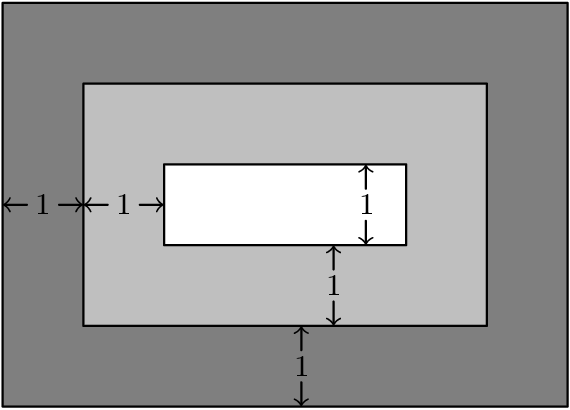
- A)
- B)
- C)
- D)
- E)
Answer
B
Key insight
With inner length x, the three region areas are x, 2x + 6 and 2x + 14; equal gaps force x + 6 = 8, so x = 2.
Solution
Let the inner rectangle be by . Adding a -foot border on every side gives a middle rectangle of size by , and another border gives the outer rectangle of size by .
The three colored regions have areas
For an arithmetic progression the consecutive differences must agree:
So and . (Check: areas .)
The answer is .
Why this works
Nested rectangles turn ring areas into differences of rectangle areas, and each ring is linear in the unknown length. The arithmetic-progression condition is simply "middle minus first equals last minus middle," one linear equation. Frame-shaped regions always come from subtracting nested areas, never from multiplying the frame's width by a single side.
Alternative approach
Test the choices: with the rectangles are , , with areas , so the rings are , evenly spaced. With the rings are , not evenly spaced.
The trap
Using the full rectangle areas 3(x+2) and 5(x+4) as the ring areas instead of subtracting the inner rectangles.
Common mistakes
- Using the full rectangle areas 3(x+2) and 5(x+4) as the ring areas instead of subtracting the inner rectangles.
- Growing each dimension by instead of when adding a border on all four sides.
Techniques
Set up the equation/formula and compute; no special trick needed · Cut the figure into known shapes (triangles, rectangles, sectors)