2019 AMC 10B Problem 8
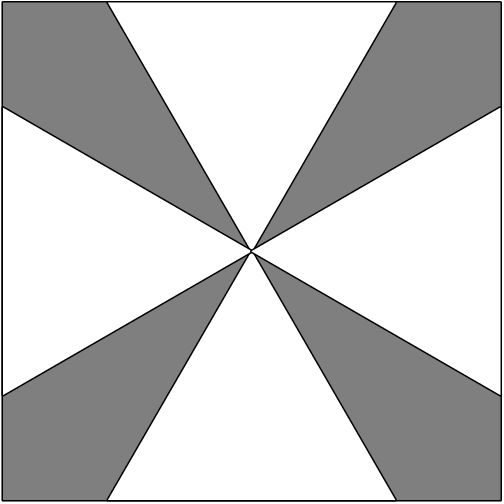
The figure below shows a square and four equilateral triangles, with each triangle having a side lying on a side of the square, such that each triangle has side length and the third vertices of the triangles meet at the center of the square. The region inside the square but outside the triangles is shaded. What is the area of the shaded region?
Show solution without answering
Key insight
Each triangle stands on a side and its tip reaches the center, so its height is half the square's side. So the square has side 2 times root 3.
Solution
The only thing we do not know yet is how big the square is. The triangles tell us.
- Height of one triangle. Cut an equilateral triangle of side down the middle. You get a right triangle with hypotenuse and short leg , so the height is .
- Size of the square. Each triangle sits on a side of the square and its top point is at the center. So the distance from the center to a side is . The side of the square is twice that: .
- Area of the square: .
- Area of the triangles. One triangle has area . Four of them: .
- Shaded area: square minus triangles, .
The answer is .
Why this works
In a figure made of several pieces, look for how one piece fixes the size of another before computing any area. Here the height of a triangle equals half the square's side because the tips meet at the center. After that, the shaded area is simply "big shape minus the pieces."
Concise solution
A shorter write-up, the way contest solutions are usually written. It may take a different route from the solution above.
An equilateral triangle of side has height . Each triangle stands on a side of the square with its apex at the center, so the distance from the center to each side of the square is . The square therefore has side and area
Each triangle has area , so the four triangles cover . The shaded region is the square minus the triangles:
The answer is .
Review in the AoPS books
- Introduction to Geometry, Chapter 8: Quadrilaterals
- Introduction to Geometry, Chapter 4: Perimeter and Area (§4.2)
- Introduction to Geometry, Chapter 9: Polygons (§9.3)
- Introduction to Geometry, Chapter 6: Right Triangles (§6.1, §6.2, §6.3)
Similar problems
Problem © Mathematical Association of America (MAA), American Mathematics Competitions. Reproduced for non-commercial educational use. Solution and commentary are original to this site.